Solomon Negash
  • Selam!
  • Books
  • Codes
  • About
  • Click to open the search input field Click to open the search input field Search
  • Menu Menu

Signing a bilateral military cooperation agreement, Egypt and Sudan warn Ethiopia not to fill the Renaissance Dam

March 2, 2021/0 Comments/in English, External, Politics/by Solomon

Cairo – Sputnik |  The Foreign Ministers of Egypt and Sudan considered that Ethiopia’s implementation of the second phase of filling the Renaissance Dam is a direct threat to the water security of the two countries.

Today, Tuesday, Egyptian Foreign Minister Sameh Shoukry and his Sudanese counterpart Maryam Al-Sadiq Al-Mahdi discussed a number of ways of cooperation between the two countries, in addition to the crisis of the Ethiopian Renaissance Dam, where they expressed concern about the stalled negotiations, and stressed the need to reach a binding agreement on filling and operating the dam that preserves the interests of the three countries. .

The two sides issued a joint statement reviewing the results of the Sudanese minister’s visit to Egypt, in which they expressed “concern about the stalled negotiations that took place under the auspices of the African Union, and stressed that Ethiopia’s implementation of the second phase of filling the Renaissance Dam unilaterally would pose a direct threat to the water security of Egypt and Sudan. ” .

The statement added, “This measure will be a material breach of the Declaration of Principles agreement concluded between the three countries in Khartoum on March 23, 2015.”

The two ministers stressed the need to continue coordination and continuous consultations between the two countries in this vital file, and they also agreed to inform the brotherly Arab countries of the developments in these negotiations.

This comes coinciding with the signing of the two countries today, Tuesday, an agreement for military cooperation between the two countries, on the sidelines of a visit by the Egyptian Chief of Staff of the Egyptian Army, Lieutenant General Mohamed Farid, to Khartoum.

The Sudanese army chief of staff, Lieutenant General Muhammad Othman Al-Hussein, said after the signing that the aim of the agreement is “to achieve national security for the two countries to build armed forces full of experience and knowledge,” directing “thanks to Egypt for standing by Sudan in difficult situations.”

For his part, Lieutenant General Mohamed Farid, Chief of Staff of the Egyptian Armed Forces, affirmed that Cairo seeks to “consolidate ties and relations with Sudan in all fields, especially military and security, and solidarity as a strategic approach imposed by the regional and international environment.”

The Egyptian Chief of Staff added that “Sudan and Egypt face common challenges and that there are multiple threats facing the national security in the two countries,” expressing his country’s readiness to meet all Sudan’s requests in all military fields, describing the level of military cooperation with Sudan as “unprecedented.”

0 0 Solomon https://solomonegash.com/wp-content/uploads/2023/01/snlogo.png Solomon2021-03-02 19:00:172026-03-10 19:31:29Signing a bilateral military cooperation agreement, Egypt and Sudan warn Ethiopia not to fill the Renaissance Dam
House Foreign Affairs Press Release: McCaul Responds to Reports of Ethnic Cleansing and Massacres of Civilians in Tigray Region
February 28, 2021/0 Comments/in English, External, News, Politics/by Solomon

Press Release House Foreign Affairs Committee 02.27.21 | Media Contact: 202-225-5021

Washington, DC – House Foreign Affairs Committee Lead Republican Michael McCaul has released the following statement in response to reports of ethnic cleansing and mass violence in the Tigray region of Ethiopia.

“The horrors detailed in the reports coming out of the Tigray region are incredibly concerning and I am looking into them further. For far too long, the government of Ethiopia and other armed actors have blocked access by journalists and independent monitors to investigate these chilling accounts. I urge the Biden Administration to take decisive action to hold those accountable for any atrocities committed. This must be a high priority as the U.S. takes on the role of UN Security Council Chair next month.”

https://solomonegash.com/wp-content/uploads/2023/01/snlogo.png 0 0 Solomon https://solomonegash.com/wp-content/uploads/2023/01/snlogo.png Solomon2021-02-28 16:03:512026-03-10 19:31:28House Foreign Affairs Press Release: McCaul Responds to Reports of Ethnic Cleansing and Massacres of Civilians in Tigray Region

US SECRETARY OF STATE: Atrocities in Ethiopia’s Tigray Region

February 28, 2021/0 Comments/in English, External, Politics/by Solomon

PRESS STATEMENT | ANTONY J. BLINKEN, SECRETARY OF STATE | FEBRUARY 27, 2021

The United States is gravely concerned by reported atrocities and the overall deteriorating situation in the Tigray region of Ethiopia.  We strongly condemn the killings, forced removals and displacements, sexual assaults, and other extremely serious human rights violations and abuses by several parties that multiple organizations have reported in Tigray.  We are also deeply concerned by the worsening humanitarian crisis.  The United States has repeatedly engaged the Ethiopian government on the importance of ending the violence, ensuring unhindered humanitarian access to Tigray, and allowing a full, independent, international investigation into all reports of human rights violations, abuses, and atrocities.  Those responsible for them must be held accountable.

The United States acknowledges the February 26 statements from the Ethiopian Office of the Prime Minister and the Ministry of Foreign Affairs promising unhindered humanitarian access, welcoming international support for investigations into human rights violations and abuses, and committing to full accountability.  The international community needs to work collectively to ensure that these commitments are realized.

The immediate withdrawal of Eritrean forces and Amhara regional forces from Tigray are essential first steps.  They should be accompanied by unilateral declarations of cessation of hostilities by all parties to the conflict and a commitment to permit unhindered delivery of assistance to those in Tigray.  The United States is committed to working with the international community to achieve these goals.  To that end, USAID will deploy a Disaster Assistance Response Team to Ethiopia to continue delivering life-saving assistance.

We ask international partners, especially the African Union and regional partners, to work with us to address the crisis in Tigray, including through action at the UN and other relevant bodies.

The United States remains committed to building an enduring partnership with the Ethiopian people.

https://solomonegash.com/wp-content/uploads/2023/01/snlogo.png 0 0 Solomon https://solomonegash.com/wp-content/uploads/2023/01/snlogo.png Solomon2021-02-28 13:14:102026-03-10 19:31:27US SECRETARY OF STATE: Atrocities in Ethiopia’s Tigray Region

VICE: Razed In Ethnic Cleansing Campaign

February 28, 2021/0 Comments/in English, External, Opinion/by Solomon

VICE |  Survivor testimony and satellite imagery in Ethiopia’s Tigray region provide evidence of wide-ranging destruction by Eritrean soldiers.

By Zecharias Zelalem | Feb 27 2021

“They set our crops on fire, then they started burning the homes,” said Gebru Habtom, a farmer in his 40s from the village of Debre Harmaz in Ethiopia. “Then they said they’d burn me next, so I fled for my life.”

Gebru, whose name has been changed to protect him from reprisals, was born and raised in the village of Debre Harmaz in central Tigray, some five miles from Ethiopia’s border with Eritrea. Like thousands of others, he has been displaced by Ethiopia’s months-long civil war.

Gebru connected with VICE World News from an undisclosed location along the Ethiopian-Sudanese border, and said that there was no sign of war or even resistance fighters present when, on January 10, Eritrean soldiers arrived in his village and went on a murderous rampage, pillaging and setting homes alight. “They shot at everyone, they even killed priests who were hiding in the church,” he said. Gebru also said that he heard about neighboring villages experiencing similar destruction that has also gone unreported.

“They shot at everyone, they even killed priests who were hiding in the church.”

Over the past month, VICE World News has documented harrowing testimony from nine displaced Tigrayans who recalled wanton slaughter, the destruction of crops and livelihoods, and tens of thousands fleeing from areas of Ethiopia’s Tigray region under Eritrean military control. Their testimony has been largely confirmed by satellite image analysis by the U.K.-based research organization DX Open Network, and their recounting and the image analysis both suggest that Eritrean soldiers involved in Ethiopia’s war in Tigray are ethnically cleansing communities near the Ethiopian-Eritrean border.

While several towns in the area have been previously reported destroyed, VICE World News found that, at minimum, an additional four villages in Tigray have likely been razed, and their inhabitants killed.

Eritrean soldiers first entered Ethiopia’s civil war to fight alongside the Ethiopian army against forces of Tigrayan People’s Liberation Front, known as TPLF, or the governing party in the region. In November, soldiers from the two countries succeeded in jointly pushing out Tigrayan forces from the regional capital, Mekelle, and have been accused by international organizations like Amnesty International and Human Rights Watch of brutal war crimes and indiscriminate shelling that targeted civilians and is believed to have left thousands dead.

Residents say that though Ethiopian prime minister Abiy Ahmed declared victory and the end of combat operations, Eritrean military units have continued attacking civilian areas, looting and killing before setting properties ablaze to render entire areas uninhabitable.

Now, Ethiopia claims it is conducting clean-up operations across parts of rural Tigray. Satellite imagery from central Tigray’s Eritrean border, however, points to something far more nefarious.

Like Debre Harmaz, the remote farming community of Adi Mendi, located three miles from Ethiopia’s border, also appears to have been destroyed. According to analysis by the DX Open Network, satellite imagery revealed that on January 19, some 478 structures, mostly tukul homes made from compressed straw, grass and mud, were set on fire. Tukul homes are common in farming communities across Ethiopia.

“Many of them were burnt alive in their homes.”

“Absence of scorching between blackened structures suggests intentional burning, not the result of a wildfire,” the DX Open Network said of the images in a statement to VICE World News. “Perpetrators likely went from structure to structure to initiate razing. And furthermore, there were no apparent indicators of any militarily valid targets.”

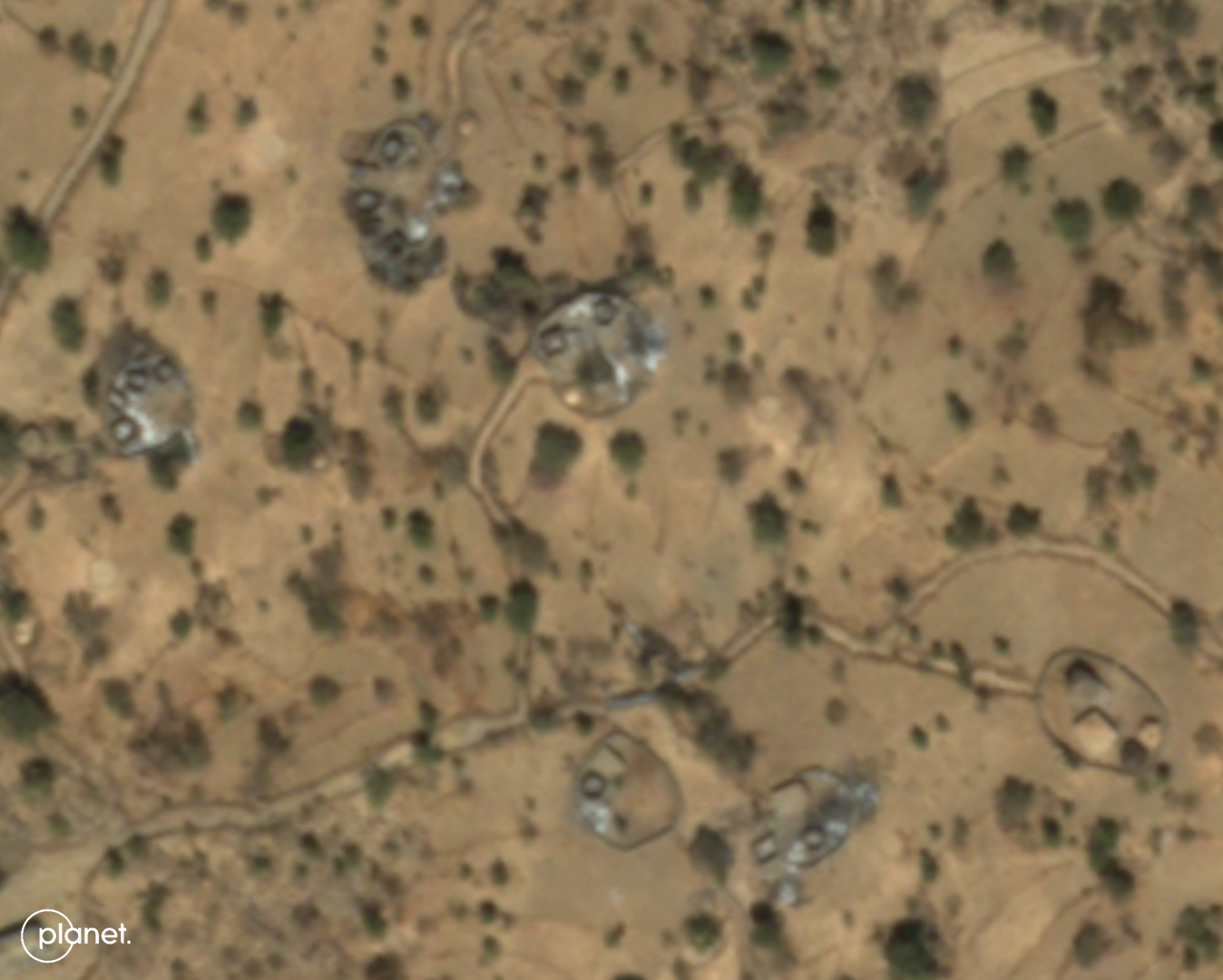
A SATELLITE IMAGE DEPICTING 478 STRUCTURES DESTROYED IN ADI MENDI, WITH PURPLE HIGHLIGHTING “CATASTROPHIC” DAMAGE, AND RED “EXTENSIVE DAMAGE. THE BEIGE MARKER INDICATES BILLOWING SMOKE VISIBLE A FULL DAY AFTER ATTACK. (COURTESY OF PLANETLABS INC)

“Many of them were burnt alive in their homes,” said Adamu Gidey, who hails from the nearby town of Rama and is well acquainted with the border areas. “I’ve met with survivors, who told me that the Adi Mendi is now a ghost town. Farmers were forced by Eritrean soldiers to slaughter their cows and prepare food for the soldiers. They later doused the homes of these same farmers in gasoline. Adi Mendi no longer exists.”

A SATELLITE IMAGE DEPICTING ADI MENDI’S SCORCHED TUKUL HOMES. ANALYSIS FROM DX OPEN NETWORK SAYS THAT BECAUSE THERE IS NO DAMAGE TO NEARBY TREES, IT IS A CLEAR INDICATOR OF DELIBERATE AND CALCULATED BURNINGS. (COURTESY OF PLANETLABS INC)

The satellite images of the visible scorched aftermath point to possibly thousands of people being rendered homeless or far worse.

“The people of Adi Mendi were farmers who would go once a month on hours-long treks to nearby areas to sell their produce, as there are no paved roads for vehicles,” said Gidey, whose name has been changed to protect his safety. “They didn’t deserve this cruelty.”

The DX Open Network’s analysis also confirmed that in recent weeks, the razing has begun to expand beyond central Tigray. The village of Ademeyti, located just south of the long contested town of Badme, and flashpoint of the 1998-2000 Ethiopian-Eritrean border war, was similarly ransacked, with homes set on fire as recently as February 16. DX Open Network shared satellite imagery of Ademeyti’s ruins with VICE World News.

While much of the war was fought under a communications blackout, as phone and internet services were severed from the entire area and aid workers and journalists were not allowed into the region, multiple reports this past week have echoed similar findings of ethnic cleansing and indiscriminate destruction. Yesterday, the New York Times published portions of a U.S. government report which stated that ethnic cleansing was rampant in northern Tigray. According to the report, “whole villages were severely damaged or completely erased.”

According to an Amnesty International report also published on Friday, Eritrean soldiers killed hundreds of civilians in the Tigrayan city of Axum from November 28 through November 29 in one of the worst atrocities of the war. Going door to door in the city’s residential areas, soldiers singled out males of fighting age and murdered them in their homes, the report stated.

Ethiopian soldiers are also accused of involvement in mass killings and are believed to have played a role in the systemic razing of two UNHCR run refugee camps.

For months, Ethiopia and Eritrea had denied reports that Eritrean soldiers were involved in Ethiopia’s civil war. But footage uploaded to the internet and credible reports of their involvement in atrocities led to U.S. officials calling on Eritrea to withdraw its forces. Refugees told VICE World News that they believed that Eritrea’s territorial control in Ethiopia likely extended beyond Tigray’s Maekelay district. The U.N. has echoed these concerns; chief coordinator of humanitarian efforts Mark Lowcock recently stated his belief that Ethiopian troops only controlled between 60% to 80% of Tigray, and that Eritrean soldiers operating in the area control much of the remaining areas, pursuing their own objectives independent of Ethiopian command.

“They aren’t just crossing the border, they are in control of the entire area.”

In February, on a panel organized by German news outlet Deutsche Welle, Ethiopia’s Foreign Ministry spokesperson Dina Mufti conceded that Eritrean soldiers “might have crossed into porous border areas to contain lawlessness.”

But refugees from the same border areas refute this. “They aren’t just crossing the border, they are in control of the entire area,” says Girmay, who requested he be referred to only by his first name  to protect his safety.

Girmay fled his family’s farm located in a village in the Maekelay district’s border areas after getting word that Eritrean soldiers were advancing on it. “Since the war started, we haven’t seen a single Ethiopian soldier. Only Eritreans,” he told VICE World News. “They occupy the rural areas.”

According to Girmay and four others who fled the region, the Eritrean state-run telecommunications provider Eri Tel’s network’s reach was expanded into Maekelay, meaning that unlike inhabitants of other parts of Tigray, left in the dark by the Ethiopian government’s communications shutdown, residents of the Maekelay district have been able to maintain their phone service, using Eritrean sim cards. Eritrean soldiers started to sell them, they said, after realizing the high demand.

“It’s as if we’re no longer part of Ethiopia,” he explained. “People calling you with numbers that have the +291 instead of the +251 area code, Eritrean soldiers in control of the area. But at least using the Eritrean numbers, we can warn our friends when there’s danger.”

The sudden expansion of Eritrea’s cellular network into parts of Eritrean occupied Ethiopia points is worrying, said Girmay. But he also believed it helped save lives, including his own.

Girmay says the tiny and mountainous Ethiopian village of Adi Fitaw, located two miles from the Eritrean border, was attacked twice by Eritrean raiding parties; first in mid-December and later on January 11. He told VICE World News that he fled his own home, located in a nearby village, after being warned over the phone of the second attack.

After VICE World News asked researchers from DX Open Network about this purported attack on Adi Fitaw, the organization’s researchers obtained satellite imagery from the town which they analyzed and found that approximately a dozen homes in the village were destroyed in fire-based attacks that occurred prior to January 5.

“Like the many similar attacks in rural communities, there are no apparent indicators of militarily valid targets in Adi Fitaw and there are clear indicators of the deliberate burning of homes there,” DX Open Network said.

Betre Gebreselassie hails from May Wedenberai, another village near Adi Fitaw, and currently lives in Melbourne, Australia. “Since the Eritrean phone reception started working, I’ve learned that Eritrean soldiers burnt my aunt’s home down,” he told VICE World News. “My aunt and her neighbors were lucky to escape alive. They spent weeks sleeping under trees with almost no food.”

“Like the many similar attacks in rural communities, there are no apparent indicators of militarily valid targets in Adi Fitaw and there are clear indicators of the deliberate burning of homes there.”

His family, he said, also told of other similar stories in the region. “I know of a family of parents and two children who were burnt alive in their home,” added Gebreselassie. “They enter a home, take what they like and then burn it down. They are using camels to cart off stolen possessions.”

Betre and Girmay both said that the extent of the Maekelay district’s destroyed infrastructure and deaths is unknown, but shared the names of at least a dozen separate villages which they say were razed to the ground by the Eritrean military in a manner similar to what happened at Adi Mendi.

“The Adi Mengedi, Adi Berbere, and Haftom villages were all attacked. We’ve also learned of at least 25 deaths on January 1 at Bihiza,” Girmay said. “They burnt homes and took all the cattle, camels and food as loot.”

Neither the Ethiopian Prime Minister’s press secretary, Billene Seyoum, nor Eritrean Minister of Information Yemane Gebremeskel responded to emails sent by VICE World News seeking comment on the findings. Both governments typically rebuff such allegations, with Yemane Gebremeskel only yesterday labeling Amnesty International’s report alleging Eritrean military involvement in the Axum massacre as “fallacious.”

Most of the survivors reached by VICE World News are suffering from trauma and shock, and don’t know if they will have a home to return to once the war is over.

“I think they want to kill us all,” said Samuel, whose name has been changed and who says he witnessed soldiers shoot dead his parents, three of his neighbors, and a young child. “I don’t think it would be safe to return, even if things became peaceful. They’d want to finish what they started.”

“I think they want to kill us all.”

The situation looks increasingly grim. The Ethiopian and Eritrean governments refuse to acknowledge abuses by their forces, and preventative measures don’t appear forthcoming. International pressure is also limited: While other governments have made statements condemning nearby attacks, very little has changed.

Hirut Zeray, one of over 50,000 Ethiopians to flee into Sudan, agreed. “Sudan is my country now,” she told VICE World News. “I am safe here and the people are helping us with what little they have. But in Ethiopia, we are treated worse than animals.”

https://solomonegash.com/wp-content/uploads/2023/01/snlogo.png 0 0 Solomon https://solomonegash.com/wp-content/uploads/2023/01/snlogo.png Solomon2021-02-28 13:03:092026-03-10 20:07:55VICE: Razed In Ethnic Cleansing Campaign

Amnesty: Eritrean troops’ massacre of hundreds of Axum civilians may amount to crime against humanity

February 27, 2021/0 Comments/in English, External, Politics/by Solomon

Amnesty International | 26 February 2021 |  

Amnesty International interviewed 41 survivors and witnesses to mass killings in November

  • Troops carried out extrajudicial executions, indiscriminate shelling and widespread looting
  • Satellite imagery analysis shows evidence consistent with new burial sites

Read Full Report >>>

Eritrean troops fighting in Ethiopia’s Tigray state systematically killed hundreds of unarmed civilians in the northern city of Axum on 28-29 November 2020, opening fire in the streets and conducting house-to-house raids in a massacre that may amount to a crime against humanity, Amnesty International said today in a new report.

Amnesty International spoke to 41 survivors and witnesses – including in-person interviews with recently arrived refugees in eastern Sudan and phone interviews with people in Axum – as well as 20 others with knowledge of the events. They consistently described extrajudicial executions, indiscriminate shelling and widespread looting after Ethiopian and Eritrean troops led an offensive to take control of the city amid the conflict with the Tigray People’s Liberation Front (TPLF) in mid-November.

Satellite imagery analysis by the organization’s Crisis Evidence Lab corroborates reports of indiscriminate shelling and mass looting, as well as identifies signs of new mass burials near two of the city’s churches.

“The evidence is compelling and points to a chilling conclusion. Ethiopian and Eritrean troops carried out multiple war crimes in their offensive to take control of Axum. Above and beyond that, Eritrean troops went on a rampage and systematically killed hundreds of civilians in cold blood, which appears to constitute crimes against humanity,” said Deprose Muchena, Amnesty International’s Director for East and Southern Africa.

This atrocity ranks among the worst documented so far in this conflict. Besides the soaring death toll, Axum’s residents were plunged into days of collective trauma amid violence, mourning and mass burials.

Deprose Muchena, Amnesty International’s Director for East and Southern Africa

“This atrocity ranks among the worst documented so far in this conflict. Besides the soaring death toll, Axum’s residents were plunged into days of collective trauma amid violence, mourning and mass burials.”

The mass killings came just before the annual celebration at Axum Tsion Mariam, a major Ethiopian Orthodox Christian festival on 30 November, compounding the trauma by casting a pall over an annual event that typically draws many pilgrims and tourists to the sacred city.

Large-scale military offensive

Overview image of damage & debris around the city of Axum, in Ethiopia’s Tigray region, following an offensive by Ethiopian and Eritrean forces in November 2020. Image: Google © 2021 Maxar Technologies

On 19 November 2020, Ethiopian and Eritrean military forces took control of Axum in a large-scale offensive, killing and displacing civilians with indiscriminate shelling and shooting.

In the nine days that followed, the Eritrean military engaged in widespread looting of civilian property and extrajudicial executions.

Witnesses could easily identify the Eritrean forces. They drove vehicles with Eritrean license plates, wore distinctive camouflage and footwear used by the Eritrean army and spoke Arabic or a dialect of Tigrinya not spoken in Ethiopia. Some bore the ritual facial scars of the Ben Amir, an ethnic group absent from Ethiopia. Finally, some of the soldiers made no secret of their identity; they openly told residents they were Eritrean.

‘All we could see were dead bodies and people crying’

According to witnesses, the Eritrean troops unleashed the worst of the violence on 28-29 November. The onslaught came directly after a small band of pro-TPLF militiamen attacked the soldiers’ base on Mai Koho mountain on the morning of 28 November. The militiamen were armed with rifles and supported by residents brandishing improvised weapons, including sticks, knives and stones.

Sustained gunfire can be heard ringing out across the city in a video recorded early that day from several locations at the bottom of the mountain.

A 22-year-old man who wanted to bring food to the militia told Amnesty International: “The Eritrean soldiers were trained but the young residents didn’t even know how to shoot… a lot of the [local] fighters started running away and dropped their weapons. The Eritrean soldiers came into the city and started killing randomly.”

Survivors and witnesses said Eritrean forces deliberately and wantonly shot at civilians from about 4pm onwards on 28 November.

According to residents, the victims carried no weapons and many were running away from the soldiers when they were shot. One man who hid in an unfinished building said he saw a group of six Eritrean soldiers kill a neighbour with a vehicle-mounted heavy machine-gun on the street near the Mana Hotel: “He was standing. I think he was confused. They were probably around 10 metres from him. They shot him in the head.”

I saw a lot of people dead on the street. Even my uncle’s family. Six of his family members were killed. So many people were killed.

21-year-old male resident of Axum

A 21-year-old male resident said: “I saw a lot of people dead on the street. Even my uncle’s family. Six of his family members were killed. So many people were killed.”

The killings left Axum’s streets and cobblestone plazas strewn with bodies. One man who had run out of the city returned at night after the shooting stopped. “All we could see on the streets were dead bodies and people crying,” he said.

On 29 November, Eritrean soldiers shot at anyone who tried to move the bodies of those killed.

The soldiers also continued to carry out house-to-house raids, hunting down and killing adult men, as well as some teenage boys and a smaller number of women. One man said he watched through his window and saw six men killed in the street outside his house on 29 November. He said the soldiers lined them up and shot from behind, using a light-machine gun to kill several at a time with a single bullet.

Interviewees named scores of people they knew who were killed, and Amnesty International has collected the names of more than 240 of the victims. The organization has been unable to independently verify the overall death toll, but consistent witness testimonies and corroborating evidence make it plausible that hundreds of residents were killed.

Burying the dead

Most of the burials took place on 30 November, but the process of collecting and burying the bodies lasted several days.

Many residents said they volunteered to move the bodies on carts, in batches of five to 10 at a time; one said he transported 45 bodies. Residents estimate that several hundred people were buried in the aftermath of the massacre, and they attended funerals at several churches where scores were buried. Hundreds were buried at the largest funeral, held at the complex that includes the Arba’etu Ensessa church and the Axum Tsion St Mariam Church.

Amnesty International’s Crisis Evidence Lab geolocated a video showing people carrying a dead man on a stretcher in Da’Ero Ela Plaza (14.129918, 38.717113), towards Arba’etu Ensessa church. High-resolution satellite imagery from 13 December shows disturbed earth consistent with recent graves around the Arba’etu Ensessa and the Abune Aregawi churches.

Intimidation and looting

In the days following the burials, the Eritrean army rounded up hundreds of residents in different parts of the city. They beat some of the men, threatening them with a new round of revenge killings if they resisted.

Axum residents witnessed a surge in the Eritrean army’s looting during this period, targeting stores, public buildings including a hospital, and private homes. Luxury goods and vehicles were widely looted, as well as medication, furniture, household items, food, and drink.

International humanitarian law (the laws of war) prohibits deliberate targeting of civilians, indiscriminate attacks, and pillage (looting). Violations of these rules constitute war crimes. Unlawful killings that form part of a widespread or systematic attack against a civilian population are crimes against humanity.

“As a matter of urgency, there must be a UN-led investigation into the grave violations in Axum. Those suspected of responsibility for war crimes or crimes against humanity must be prosecuted in fair trials and victims and their families must receive full reparation,” said Deprose Muchena.“We repeat our call on the Ethiopian government to grant full and unimpeded access across Tigray for humanitarian, human rights, and media organizations.”

0 0 Solomon https://solomonegash.com/wp-content/uploads/2023/01/snlogo.png Solomon2021-02-27 12:11:342026-03-10 19:31:27Amnesty: Eritrean troops’ massacre of hundreds of Axum civilians may amount to crime against humanity

CNN: Massacre in the mountains

February 27, 2021/0 Comments/in English, External, Politics/by Solomon

CNN | They thought they’d be safe at a church. Then the soldiers arrived

By Bethlehem Feleke, Eliza Mackintosh, Gianluca Mezzofiore and Katie Polglase | February 27, 2021 

All of the witnesses to this massacre have been given pseudonyms at their request due to fears of retribution.

Abraham began burying the bodies in the morning and didn’t stop until nightfall.

The corpses, some dressed in white church robes drenched in blood, were scattered in arid fields, scrubby farmlands and a dry riverbed. Others had been shot on their doorsteps with their hands bound with belts. Among the dead were priests, old men, women, entire families and a group of more than 20 Sunday school children, some as young as 14, according to eyewitnesses, parents and their teacher.

Abraham recognized some of the children immediately. They were from his town in Ethiopia’s northern Tigray region, Edaga Hamus, and had also fled fighting there two weeks earlier. As clashes raged, Abraham and his family, along with hundreds of other displaced people, escaped to Dengelat, a nearby village in a craggy valley ringed by steep, rust-colored cliffs. They sought shelter at Maryam Dengelat, a historic monastery complex famed for a centuries-old, rock-hewn church.

On November 30, they were joined by scores of religious pilgrims for the Orthodox festival of Tsion Maryam, an annual feast to mark the day Ethiopians believe the Ark of the Covenant was brought to the country from Jerusalem. The holy day was a welcome respite from weeks of violence, but it would not last.

A group of Eritrean soldiers opened fire on Maryam Dengelat church while hundreds of congregants were celebrating mass, eyewitnesses say. People tried to flee on foot, scrambling up cliff paths to neighboring villages. The troops followed, spraying the mountainside with bullets.

A CNN investigation drawing on interviews with 12 eyewitnesses, more than 20 relatives of the survivors and photographic evidence sheds light on what happened next.

The soldiers went door to door, dragging people from their homes. Mothers were forced to tie up their sons. A pregnant woman was shot, her husband killed. Some of the survivors hid under the bodies of the dead.

The mayhem continued for three days, with soldiers slaughtering local residents, displaced people and pilgrims. Finally, on December 2, the soldiers allowed informal burials to take place, but threatened to kill anyone they saw mourning. Abraham volunteered.

Under their watchful eyes, he held back tears as he sorted through the bodies of children and teenagers, collecting identity cards from pockets and making meticulous notes about their clothing or hairstyle. Some were completely unrecognizable, having been shot in the face, Abraham said.

Then he covered their bodies with earth and thorny tree branches, praying that they wouldn’t be washed away, or carried off by prowling hyenas and circling vultures. Finally he placed their shoes on top of the burial mounds, so he could return with their parents to identify them.

One was Yohannes Yosef, who was just 15.

“Their hands were tied … young children … we saw them everywhere. There was an elderly man who had been killed on the road, an 80-something-year-old man. And the young kids they killed on the street in the open. I’ve never seen a massacre like this and I don’t want to [again],” Abraham said.

“We only survived by the grace of God.”

Abraham said he buried more than 50 people that day, but estimates more than 100 died in the assault.

They’re among thousands of civilians believed to have been killed since November, when Ethiopian Prime Minister Abiy Ahmed, who was awarded the Nobel Peace Prize in 2019 for resolving a long-running conflict with neighboring Eritrea, launched a major military operation against the political party that governs the Tigray region. He accused the Tigray People’s Liberation Front (TPLF), which ruled Ethiopia for nearly three decades before Abiy took office in 2018, of attacking a government military base and trying to steal weapons. The TPLF denies the claim.

The conflict is the culmination of escalating tensions between the two sides, and the most dire of several recent ethno-nationalist clashes in Africa’s second-most populous country.

After seizing control of Tigray’s main cities in late November, Abiy declared victory and maintained that no civilians were harmed in the offensive. Abiy has also denied that soldiers from Eritrea crossed into Tigray to support Ethiopian forces.

But the fighting has raged on in rural and mountainous areas where the TPLF and its armed supporters are reportedly hiding out, resisting Abiy’s drive to consolidate power. The violence has spilled over into local communities, catching civilians in the crossfire and triggering what the United Nations refugee agency has called the worst flight of refugees from the region in two decades.

The UN special adviser on genocide prevention said in early February that the organization had received multiple reports of “extrajudicial killings, sexual violence, looting, mass executions and impeded humanitarian access.”

Many of those abuses have been blamed on Eritrean soldiers, whose presence on the ground suggests that Abiy’s much-lauded peace deal with Eritrean President Isaias Afwerki set the stage for the two sides to wage war against the TPLF — their mutual enemy.

The US State Department, in a statement to CNN, called for Eritrean forces to be “withdrawn from Tigray immediately,” citing credible reports of their involvement in “deeply troubling conduct.” In response to CNN’s findings, the spokesperson said “reports of a massacre at Maryam Dengelat are gravely concerning and demand an independent investigation.”

Ethiopia responded to CNN’s request for comment with a statement that did not directly address the attack in Dengelat. The government said it would “continue bringing all perpetrators to justice following thorough investigations into alleged crimes in the region,” but gave no details about those investigations.

“They were taking them barefoot and killing them in front of their mothers” Rahwa

CNN has reached out for comment to Eritrea, which has yet to respond. On Friday, the government vehemently denied its soldiers had committed atrocities during another massacre in Tigray reported by Amnesty International.

The TPLF said in a statement to CNN that its forces were nowhere near Dengelat at the time of the massacre. It rejected that the victims could have been mistaken for being TPLF and called for a UN investigation to hold all sides accountable for atrocities committed during the conflict.

Still, the situation inside the country remains opaque. Ethiopia’s government has severely restricted access to journalists and prevented most aid from reaching areas beyond the government’s control, making it challenging to verify accounts from survivors. And an intermittent communications blackout during the fighting has effectively blocked the war from the world’s eyes.

Now that curtain is being pulled back, as witnesses fleeing parts of Tigray reach internet access and phone lines are restored. They detail a disastrous conflict that has given rise to ethnic violence, including attacks on churches and mosques.

For months, rumors spread of a grisly assault on an Orthodox church in Dengelat. A list of the dead began circulating on social media in early December, shared among the Tigrayan diaspora. Then photos of the deceased, including young children, started cropping up online.

Through a network of activists and relatives, CNN tracked down eyewitnesses to the attack. In countless phone calls — many disconnected and dropped — Abraham and others provided the most detailed account of the deadly massacre to date.

Eyewitnesses said that the festival started much as it had any other year. Footage of the celebrations from 2019 shows priests dressed in white ceremonial robes and crowns, carrying crosses aloft, leading hundreds of people in prayer at Maryam Dengelat church. The faithful sang, danced and ululated in unison.

As prayers concluded in the early hours of November 30, Abraham looked out from the hilltop where the church is perched to see troops arriving by foot, followed by more soldiers in trucks. At first, they were peaceful, he said. They were invited to eat, and rested under the shade of a tree grove.

But, as congregants were celebrating mass around midday, shelling and gunfire erupted, sending people fleeing up mountain paths and into nearby homes.

Desta, who helped with preparations for the festival, said he was at the church when troops arrived at the village entrance, blocking off the road and firing shots. He heard people screaming and fled, running up Ziqallay mountainside. From the rocky plateau he surveyed the chaos playing out below.

We could see people running here and there … [the soldiers] were killing everyone who was coming from the church,” Desta said.

Eight eyewitnesses said they could tell the troops were Eritrean, based on their uniforms and dialect. Some speculated that soldiers were meting out revenge by targeting young men, assuming they were members of the TPLF forces or allied local militias. But Abraham and others maintained there were no militia in Dengelat or the church.

Marta, who was visiting Dengelat for the holiday, says she left the church with her husband Biniam after morning prayers. As the newlyweds walked back to their relative’s home, a stream of people began sprinting up the hill, shouting that soldiers were rounding people up in the village.

She recalled the horrifying moment soldiers arrived at their house, shooting into the compound and calling out: “Come out, come out you b*tches.” Marta said they went outside holding their identity cards aloft, saying “we’re civilians.” But the troops opened fire anyway, hitting Biniam, his sister and several others.

“I was holding Bini, he wasn’t dead … I thought he was going to survive, but he died [in my arms].

The couple had just been married in October. Marta found out after the massacre that she was pregnant.

After the soldiers left, Marta, who said she was shot in the hand, helped drag the seven bodies inside, so that the hyenas wouldn’t eat them. “We slept near the bodies … and we couldn’t bury them because they [the soldiers] were still there,” she said.

Marta and other eyewitnesses described soldiers going house to house through Dengelat, dragging people outside, binding their hands or asking others to do so, and then shooting them.

Rahwa, who was part of the Sunday school group from Edaga Hamus and left Dengelat earlier than others, managing to escape being killed, said mothers were forced to tie up their sons.

“They were ordering their mothers to tie their sons’ hands. They were taking them barefoot and killing them in front of their mothers,” Rahwa said eyewitnesses told her.

Samuel, another eyewitness, said that he had eaten and drank with the soldiers before they came to his house, which is just behind the church, and killed his relatives. He said he survived by hiding underneath one of their bodies for hours.

“They started pushing the people out of their houses and they were killing all children, women and old men. After they killed them outside their houses, they were looting and taking all the property,” Samuel said.

As the violence raged, hundreds of people remained in the church hall. In a lull in the gunfire, priests advised those who could to go home, ushering them outside. Several of the priests were killed as they left the church, Abraham said.

With nowhere to run to, Abraham sheltered inside Maryam Dengelat, lying on the floor as artillery pounded the tin roof. “We lost hope and we decided to stay and die at the church. We didn’t try to run,” he said.

Two days later, the troops called parishioners down from the church to deal with the dead. Abraham said he and five other men spent the day burying bodies, including those from Marta’s household and the Sunday school children. But the troops forbid them from burying bodies at the church, in line with Orthodox tradition, and forced them to make mass graves instead — a practice that has been described elsewhere in Tigray.

“… most of them were eaten by vultures before they got buried, it was horrible” Tedros

Abraham shared photos and videos of the grave sites, which CNN geolocated to Dengelat with the help of satellite image analysis from several experts. The analysis was unable to conclusively identify individual graves, which witnesses said were shallow, but one expert said there were signs that parts of the landscape had changed.

The initial bloodshed was followed by a period of two tense weeks, Abraham said. Soldiers stayed in the area in several encampments, stealing cars, burning crops and killing livestock before eventually moving on.

Tedros, who was born in Dengelat and traveled there after the soldiers had left, said that the village smelled of death and that vultures were circling over the mountains, a sign that there may be more bodies left uncounted there.

“Some of them were also killed in the far fields while they were trying to escape and most of them were eaten by vultures before they got buried, it was horrible. [The soldiers] tied them and killed them in front of their doors, and they shot them in the head just to save bullets,” he said.

Tedros visited the burial grounds described by eyewitnesses and said he saw cracks in the church walls where artillery hit. In interviews with villagers and family members, he compiled a death toll of more than 70 people.

The families hope that the names of their loved ones, which Tedros, Abraham and others risked their lives to record, will eventually be read out at a traditional funeral ceremony at the Maryam Dengelat church — rare closure in an ongoing conflict.

Three months after the massacre, the graves in Dengelat are a daily reminder of the bloodshed for the survivors who remain in the village. But it has not yet been safe enough to rebury the bodies of those who died, and that reality is weighing on them

 

https://solomonegash.com/wp-content/uploads/2023/01/snlogo.png 0 0 Solomon https://solomonegash.com/wp-content/uploads/2023/01/snlogo.png Solomon2021-02-27 12:05:002026-03-10 19:31:26CNN: Massacre in the mountains

NYT: Ethiopia’s War Leads to Ethnic Cleansing in Tigray Region, U.S. Report Says

February 27, 2021/0 Comments/in English, External, Politics/by Solomon

An internal U.S. government report found that people in Tigray are being driven from their homes in a war begun by Ethiopia, an American ally — posing President Biden’s first major test in Africa.

The New York Times | Declan Walsh | Published Feb. 26, 2021 Updated Feb. 27, 2021, 12:43 a.m. ET

NAIROBI, Kenya — Ethiopian officials and allied militia fighters are leading a systematic campaign of ethnic cleansing in Tigray, the war-torn region in northern Ethiopia, according to an internal United States government report obtained by The New York Times.

The report, written earlier this month, documents in stark terms a land of looted houses and deserted villages where tens of thousands of people are unaccounted for.

Fighters and officials from the neighboring Amhara region of Ethiopia, who entered Tigray in support of Prime Minister Abiy Ahmed, are “deliberately and efficiently rendering Western Tigray ethnically homogeneous through the organized use of force and intimidation,” the report says.

“Whole villages were severely damaged or completely erased,” the report said.

In a second report, published Friday, Amnesty International said that soldiers from Eritrea had systematically killed hundreds of Tigrayan civilians in the ancient city of Axum over a 10-day period in November, shooting some of them in the streets.

The worsening situation in Tigray — where Mr. Abiy, winner of the 2019 Nobel Peace Prize, launched a surprise military offensive in November — is shaping up to be the Biden administration’s first major test in Africa. Former President Donald J. Trump paid little attention to the continent and never visited it, but President Joseph R. Biden has promised a more engaged approach.

In a call with President Uhuru Kenyatta of Kenya on Thursday, Mr. Biden brought up the Tigray crisis. The two leaders discussed “the deteriorating humanitarian and human rights crises in Ethiopia’s Tigray region and the need to prevent further loss of life and ensure humanitarian access,” a White House statement said.

But thus far Mr. Biden and other American officials have been reluctant to openly criticize Mr. Abiy’s conduct of the war, while European leaders and United Nations officials, worried about reports of widespread atrocities, have been increasingly outspoken.

On Tuesday a European Union envoy, Finland’s foreign minister, Pekka Haavisto, told reporters the situation in Tigray was “very out of control,” after returning from a fact-finding trip to Ethiopia and Sudan. The bloc suspended $110 million in aid to Ethiopia at the start of the conflict, and last month the E.U.’s foreign policy chief, Josep Borrell, warned of possible war crimes in Tigray and said that the crisis was “unsettling” the entire region.

Ethiopia routinely dismisses critics of its campaign in Tigray as stooges of its foes in Tigray. But on Friday afternoon, in response to the Amnesty International report, Mr. Abiy’s office said it was ready to collaborate in an international investigation into atrocities in Tigray. The government “reiterates its commitment to enabling a stable and peaceful region,” it said in a statement.

Mr. Abiy’s office also claimed that Ethiopia has given “unfettered” access to international aid groups in Tigray — in contrast with U.N. officials who estimate that just 20 percent of the region can be reached by aid groups because of government-imposed restrictions.

The new U.S. Secretary of State, Antony J. Blinken, spoke with Mr. Ahmed by phone on Feb. 4 and urged him to allow humanitarian access to Tigray, the State Department said.

Alex de Waal, an expert on the Horn of Africa at the Fletcher School of Law and Diplomacy at Tufts University, said it is time for the United States to urgently focus on the crisis in Tigray, before more atrocities are committed and the humanitarian crisis lurches toward a famine.

“What is needed is political leadership at the highest level, and that means the U.S.,” he said.

When the United States assumes the chair of the United Nations Security Council in March, Mr. de Waal said, it should use that position to bring international pressure to bear on the belligerents to step back from a ruinous conflict.

Mr. Abiy launched the Tigray campaign on Nov. 4 following months of tension with the regional ruling party, the Tigray People’s Liberation Front, which ruled Ethiopia with a tight grip for almost three decades until Mr. Abiy came to power in 2018.

But many of the worst abuses of the war have been blamed not on the Ethiopian military or the T.P.L.F. — whose armed wing is now known as the Tigray Defense Forces — but on the irregular and undeclared forces that have rallied behind Mr. Abiy’s military campaign.

Within weeks of the start of the conflict came the first reports that soldiers from Eritrea —Ethiopia’s bitter rival until the two countries reached a peace deal in 2018 — had quietly crossed into Tigray to assist Mr. Abiy’s overstretched federal forces.

In western Tigray ethnic fighters from Amhara — a region with a long rivalry with Tigray — flooded in, quickly helping Mr. Abiy capture the area.

Now it is the Eritreans and Amhara fighters who face the most serious accusations including rape, plunder and massacres that, experts say, could constitute war crimes.

The American government report about the situation in western Tigray, an area now largely controlled by Amhara militias, documents in vivid terms what it describes as an apparent campaign to force out the ethnic Tigrayan population under the cover of war.

The report documents how in several towns ethnic Tigrayans had been attacked and had their homes pillaged and burned. Some had fled into the bush; others crossed illegally into Sudan and still others had been rounded up and forcibly relocated to other parts of Tigray, the report said.

In contrast, towns with a majority Amharan population were thriving, with bustling shops, bars and restaurants, the report said.

The American report is not the first accusation of ethnic cleansing since the Tigray crisis erupted. But it does highlight how U.S. officials are quietly documenting those abuses, and reporting them to superiors in Washington.

The looming specter of mass hunger is also driving the sense of urgency over Tigray. At least 4.5 million people in the region urgently need food aid, according to the Tigray Emergency Coordination Center, which is run by Ethiopia’s federal government. Ethiopian officials say that some people have already died.

A document from Tigray’s regional government dated Feb. 2 and obtained by The Times notes that 21 people starved to death in the eastern Tigray district of Gulomokeda. Such numbers could be just the tip of the iceberg, aid officials warned.

“Today it could be one, two or three, but you know after a month it means thousands,” Abera Tola, the president of the Ethiopian Red Cross Society, told reporters earlier this month. “After two months it will be tens of thousands.”

The political outrage over Tigray, though, especially among European lawmakers, is being fueled by the growing tide of accounts of human rights abuses.

The Amnesty International report published Friday asserts that Eritrean soldiers conducted house-to-house searches in Axum in November, shooting civilians in the street and conducting extrajudicial executions of men and boys. When the shooting stopped, residents who tried to remove the bodies from the street were fired upon, the report says.

Amnesty said the massacre was likely a crime against humanity. Eritrea’s information minister, Yemane G. Meskel, rejected the report, calling it “transparently unprofessional.”

Axum, a city of ancient ruins and churches, holds great significance to followers of the Ethiopian Orthodox faith. When the Eritrean soldiers relented and allowed the bodies to be collected, hundreds were piled up in churches, including the Church of St. Mary of Zion, where many Ethiopians believe that the ark of the covenant — said to hold the tablets inscribed with the Ten Commandments — is housed.

Simon Marks contributed reporting from Addis Ababa, Ethiopia.

https://solomonegash.com/wp-content/uploads/2023/01/snlogo.png 0 0 Solomon https://solomonegash.com/wp-content/uploads/2023/01/snlogo.png Solomon2021-02-27 11:37:052026-03-10 19:31:25NYT: Ethiopia’s War Leads to Ethnic Cleansing in Tigray Region, U.S. Report Says

EU: Tigray conflict – Joint Statement by HR/VP Borrell and Commissioner Lenarčič on massacres in Axum

February 26, 2021/0 Comments/in English, External, Politics/by Solomon

EU | Brussels, 26/02/2021 – 14:10, UNIQUE ID: 210226_7

Amnesty International issued a report today on atrocities that took place in Axum, Ethiopia, in November 2020. The report concludes that indiscriminate shelling and mass execution may amount to war crimes and crimes against humanity. This is another harrowing reminder of the violence that civilians in Tigray have been suffering since the onset of the conflict. We condemn, in the strongest possible terms, all crimes against civilians and call for the perpetrators to be swiftly brought to justice. We recall the obligation under International Humanitarian Law for all parties to ensure the protection of all civilians, including refugees and those internally displaced.

Hostilities must cease immediately and immediate, full and unfettered access to the whole of Tigray for all humanitarian actors and the media allowed. Since the outbreak of the conflict more than 100 days ago, thousands of civilians have lost their lives and reportedly 80% of the population remain cut off from external assistance, facing rising food insecurity and malnutrition. The level of suffering endured by civilians, including children, is appalling. This must cease immediately. Full access is essential to assess the situation on the ground and provide adequate protection and assistance to those who desperately need it.


Report issued today by @amnesty on atrocities that took place in #Axum, #Ethiopia in Nov 2020 is another harrowing reminder of the violence that civilians in #Tigray have been suffering since the conflict broke out.

Joint statement w/@JanezLenarcic #AUEU https://t.co/nhBzWKBbqx

— Josep Borrell Fontelles (@JosepBorrellF) February 26, 2021


In late November last year, Eritrean troops in #Tigray committed a massacre that claimed the lives of hundreds of civilians. Our new briefing investigates what happened before, during and after those harrowing 24 hours.

Read it here: https://t.co/guNPdPj19l ?

— Amnesty International (@amnesty) February 26, 2021

https://solomonegash.com/wp-content/uploads/2023/01/snlogo.png 0 0 Solomon https://solomonegash.com/wp-content/uploads/2023/01/snlogo.png Solomon2021-02-26 19:32:592026-03-10 19:31:24EU: Tigray conflict – Joint Statement by HR/VP Borrell and Commissioner Lenarčič on massacres in Axum

EU envoy says Ethiopia in ‘denial’ over Tigray

February 24, 2021/0 Comments/in English, External, Politics/by Solomon

devEx | When it comes to the conflict in northern Ethiopia, the federal government in Addis Ababa has no common understanding of events and is in “denial” over the scale of the problem, said Pekka Haavisto, European Union envoy, on Tuesday.

With negligible humanitarian access to the Tigray region since fighting broke out in November, Haavisto, Finland’s foreign minister, traveled to the region recently to assess the situation on behalf of the EU. He met with Ethiopian government ministers and Prime Minister Abiy Ahmed, and he visited the Um Rakuba refugee camp in Sudan.

On Monday, he reported to EU foreign ministers in Brussels, and the bloc’s foreign service will now prepare a document outlining the 27 member states’ common position.

“Almost four months into the conflict, 80% of the Tigray population of 6 million people remain unreachable,” Josep Borrell, EU high representative for foreign affairs, told reporters after Monday’s meeting. Borrell also reiterated calls for full humanitarian access and investigations into alleged human rights abuses.

“When you are in the middle of crises, usually people say things cannot get worse. But unfortunately, they can get even worse.”

— Pekka Haavisto, European Union envoy and Finnish foreign minister

Describing his meetings with top Ethiopian government officials, Haavisto told reporters in Brussels on Tuesday that “in the public domain, there is still also some kind of denial of the magnitude of the problems in the country.” Asked whether the state of denial was also reflected in his private conversations, Haavisto said that there were varying accounts on the issues of humanitarian access and human rights violations, even within the federal government.

“My picture was that even the government themselves do not have a clear picture, particularly areas controlled by Eritreans, probably areas controlled by Amhara militias,” he said. “This is the problem: That the picture, even in Addis Ababa, on what has happened, is missing. And of course, we have to admit that we don’t know exactly what has happened. [The] rumors, anecdotal evidence, is very concerning.”

Haavisto added that the EU could be useful in supporting a necessary “national dialogue” in Ethiopia where the country “would address properly the future of the Tigray area, the needs of the Tigray people after this law enforcement operation, because there is a lot of bitterness.” His description of a “law enforcement operation” — the term preferred by the Ethiopian government — contrasted with Borrell, who said at the Monday press conference that “we can call it a war.”

In December, the EU postponed €88 million in budget support to the Ethiopian government in protest of the conflict, with Jutta Urpilainen, EU commissioner for international partnerships, saying last week that the payout of a further €100 million ($120 million) due this year was also in doubt. However, some EU member states have continued their own bilateral support to the Ethiopian government.

An EU official, speaking on condition of anonymity, told reporters last week that that discrepancy would be “on the table” at Monday’s meeting. “I think it is one of the subjects that we have to discuss openly among member states,” the official said.

Haavisto said Tuesday that he supported the postponement of EU budget support as a “wake-up call” to the Ethiopian government and that “if things start getting from bad to worse,” then “I’m sure that then of course everybody has to look at their support and analyze it.”

He added: “When you are in the middle of crises, usually people say things cannot get worse. But unfortunately, they can get even worse.”


https://solomonegash.com/wp-content/uploads/2023/01/snlogo.png 0 0 Solomon https://solomonegash.com/wp-content/uploads/2023/01/snlogo.png Solomon2021-02-24 19:48:142026-03-10 19:31:23EU envoy says Ethiopia in ‘denial’ over Tigray

U.N. Report Accuses Blackwater Founder Erik Prince of Libya Weapons Ban Violations, Diplomat Says

February 21, 2021/0 Comments/in English, External, Politics/by Solomon

WSJ | Jared Malsin* | Mr. Prince likely to be referred to the U.N.’s Sanctions Committee, which could order a freeze on his assets or a travel ban

DUBAI—A United Nations report accuses Blackwater founder Erik Prince of assisting in violations of an international arms embargo on Libya, placing the military contractor at risk of U.N. sanctions, according to a diplomat with access to the report.

The report by the U.N. Panel of Experts that monitors the ban on transfers of weapons to Libya says companies controlled by Mr. Prince provided three aircraft to assist in sending helicopters and military contractors to help Russian-backed Libyan warlord Khalifa Haftar in 2019.

The plan to send Western mercenaries to Libya developed as foreign weapons and fighters poured into the country in 2019 and 2020 from a variety of outside powers, including Russia, Turkey and the United Arab Emirates, deepening a conflict that has been ongoing since 2014, the report says, according to the diplomat.

Mr. Prince is likely to be referred to the U.N.’s Sanctions Committee, which could order a freeze on his assets or a travel ban, according to the New York-based diplomat and a former official with knowledge of the situation. The permanent members of the Security Council, including the U.S., Russia, or China, could veto any potential sanctions against Mr. Prince, who has had dealings with all three countries.

“Erik Prince had absolutely nothing to do with any operation in Libya in 2019, or at any other time,” a spokesman for Mr. Prince said in an email.

A U.N. spokesman said the organization had no specific comment on the Panel of Experts report.

“It is incumbent on our member states to ensure that the sanctions are respected and enforced,” said U.N. spokesman Stephane Dujarric De La Rivière.

The report itself has been finalized and submitted to the U.N.’s headquarters in New York. It is unlikely to be altered before it is released to the public in the coming weeks, according to diplomats.

Mr. Prince, a former Navy SEAL, came to prominence during the Iraq war, when Blackwater provided private security guards to U.S. officials and contractors working for the company shot dead more than a dozen Iraqi civilians in a 2007 mass killing in Baghdad. Blackwater has since changed its name to Xe Services and later Academi.

Mr. Prince’s financial and political ambitions rose because of his close relationship to the Trump administration. Mr. Prince is the brother of Mr. Trump’s former education secretary, Betsy DeVos. In December, Mr. Trump pardoned the four Blackwater guards accused in the 2007 killings.

Shell companies

According to the diplomat, the forthcoming U.N. report says companies controlled by Mr. Prince sold three aircraft to people who sent Western mercenaries and military hardware to aid Mr. Haftar in the opening months of the commander’s failed assault on Libya’s internationally recognized government in Tripoli. Launched in April 2019, Mr. Haftar’s attack on the capital plunged Libya into its worst fighting since the armed rebellion that overthrew Col. Moammar Gadhafi in 2011.

According to the diplomat, the U.N. panel’s report says that firms controlled by Mr. Prince sold three aircraft through a series of shell companies to a Dubai-based company, Lancaster 6, which sent helicopters and a group of Western mercenaries to Libya to support Mr. Haftar. The plan unraveled, and the fighters left Libya.

One of the planes, a Pilatus PC-6, was delivered to Libya for use in reconnaissance and intelligence operations for Mr. Haftar’s forces, according to the diplomat with access to the report. A U.S. company, TST Humanitarian Surveys, controlled by Mr. Prince through a U.S.-based attorney, sold the plane to another company in Austria partly owned by Mr. Prince, which then sold it to Lancaster 6 in June 2019, the diplomat with access to the report said. The plane arrived in Libya days later, according to the diplomat.

The other two planes, including an Antonov An-26 cargo plane intended to transport helicopters, arrived in Jordan and didn’t fly to Libya, but were identified in the report as part of a broader plan to send military aid to Mr. Haftar.

The plan also involved several associates of Mr. Prince, according to the diplomat and the former official with knowledge of the situation. The operation was first reported last year by Bloomberg and the New York Times. Until now, U.N. investigators hadn’t directly accused Mr. Prince of being involved in the scheme.

Helicopter deal

Using funds from a Dubai-based company and a cover story involving a fake plan for a geospatial survey in Jordan, the team later obtained in South Africa three Aérospatiale Gazelle helicopters and three Super Puma helicopters. At least one of the helicopters was transported to Libya. The helicopters were purchased for a total of more than $13 million, a price well above their market value and one that suggested profit was a key motive behind the operation.

“This is basically a scheme where they wanted to make money around procurement of weapons,” said the former official with knowledge of the situation.

The role in the effort of companies based in Dubai also highlights Mr. Prince’s close ties to the United Arab Emirates and its ruler, Crown Prince Mohammed Bin Zayed. Mr. Prince has been linked to a range of mercenary efforts on behalf of the Emirates, including an effort to combat Somali pirates, according to a previous U.N. report. The U.A.E. also has been a key military backer of Mr. Haftar, sending air defenses, armed drones, ammunition and airplanes to support the militia leader’s campaigns, according to multiple U.N. reports. Mr. Prince visited Abu Dhabi in recent weeks, according to the diplomat.

The U.N. report, the diplomat said, also accuses Mr. Prince of violating a U.N. Security Council resolution by failing to provide information about the alleged violations of the arms embargo when contacted by the Panel of Experts.

In addition to naming Mr. Prince in the report, the U.N. Panel of Experts is also expected to separately refer Mr. Prince to the United Nations’ Sanctions Committee, which will make a decision about whether to impose an asset freeze or travel ban to be implemented by individual countries including the U.S., the diplomat said.


* Write to Jared Malsin at jared.malsin@wsj.com

https://solomonegash.com/wp-content/uploads/2023/01/snlogo.png 0 0 Solomon https://solomonegash.com/wp-content/uploads/2023/01/snlogo.png Solomon2021-02-21 14:49:122026-03-10 19:31:22U.N. Report Accuses Blackwater Founder Erik Prince of Libya Weapons Ban Violations, Diplomat Says
Page 7 of 59«‹56789›»
Popular
  • From Oslo to The Hague – The journey of Abiy Ahmed...November 7, 2020 - 3:06 pm
  • Reads Atlas Shrugged
    My top reads of 2023December 31, 2023 - 3:40 pm
  • የትግራይ ህዝብ እና የህውሓት ግኑኝነት...September 29, 2016 - 12:30 am
  • ጸበባን ቃልሲን ህዝቢ ትግራይ ከመይ...January 26, 2021 - 1:36 pm
  • ከምጽዓተ ኢትዮጵያ እንተርፍ ይሆን?...December 29, 2023 - 7:29 pm
  • Wooldridge chapter 4 – ExamplesJanuary 6, 2019 - 11:30 pm
  • IPIS Briefing March 2021 – Ethiopia-Tigray ConflictApril 10, 2021 - 7:03 pm
  • Spatial Mapping of Education DataDecember 24, 2018 - 12:01 am
  • ሶስቱ የጥፋት ፈረሶችና የኢትዮጵያ...November 12, 2020 - 5:48 pm
  • ትርጉም የለሽ ምጥ የለም!November 30, 2020 - 8:35 pm
  • መንግስት እና የህዝብ አስተዳደር –...March 5, 2017 - 2:19 am
  • በአዲስ አበባና በሌሎች ከተሞች የሚታዩ...February 8, 2019 - 3:23 pm
Recent
  • ፍራንከንስታይን፥ አዲስ መፅሓፍ በገበያ...February 18, 2026 - 6:15 pm
  • My Top Reads of 2025December 15, 2025 - 4:31 pm
  • ሓንሳዕ ንደማመፅ እሞ!!October 18, 2025 - 6:16 pm
  • Great Ideas E04. Liberation, Then ReflectionOctober 10, 2025 - 6:54 pm
  • Great Ideas E03 – The Median Isn’t the MessageOctober 3, 2025 - 3:16 pm
  • ሃቅ ሃቁን ብቻ እናውራ ከተባለ ̷...October 1, 2025 - 11:55 pm
  • Great Ideas E02 – Great Scientific Ideas That Changed...September 26, 2025 - 1:30 pm
  • Great Ideas E01 – I, PencilSeptember 20, 2025 - 2:53 pm
  • My Replication Codes Project Gains Wider RecognitionSeptember 11, 2025 - 7:02 pm
  • Free GIS & Remote‑Sensing Toolkit 🌍April 18, 2025 - 9:18 pm
  • ኢትዮጵያ የ ዘረመል ለውጥ የተደረገባቸውን...April 17, 2025 - 4:56 pm
  • Emerging Trend in Post-War TigrayApril 12, 2025 - 12:30 pm
Comments
  • NATNAEL ENDALAMAW DERSHEየገብረህወት ባይከዳኝ መጥሃፍ መንግስት...November 20, 2025 - 5:40 pm by NATNAEL ENDALAMAW DERSHE
  • ሙለርትኽክል አለኻ ፀላኢኻን ፈታዊኻን ፈሊኻ...October 19, 2025 - 8:06 am by ሙለር
  • AwetThis is a very reflective essay about Tigray’s political...October 18, 2025 - 9:13 pm by Awet
  • Solomonሰላም ደረጀ ጽሁፉን እንዴት ማግኘት...April 19, 2025 - 8:32 pm by Solomon
  • ደረጀሶል የዶ/ር ተወልደ አርቲክል በሶፍት...April 19, 2025 - 7:35 pm by ደረጀ
  • Solomonእንኳዕ ሓቢሩ አብጽሓና!January 2, 2024 - 3:13 pm by Solomon
  • Solomonእንኳን አብሮ አደረሰን Babi!January 2, 2024 - 3:13 pm by Solomon
  • SolomonThank you Chombe, I wish you the same!January 2, 2024 - 3:12 pm by Solomon
  • Solomonአሰስ ብትል አንዳንዶቹን ኦንላይን...January 2, 2024 - 3:11 pm by Solomon
  • Brehaneእንኳዕ አብፅሓካ ሰሌ!January 2, 2024 - 2:46 am by Brehane
  • Babiሶል እንኳን አደረሰህ!January 1, 2024 - 7:34 am by Babi
  • ChombeThank you! All the best for 2024!December 31, 2023 - 9:03 pm by Chombe
©2026 - Solomon Negash
  • Home
  • Cons.Book
  • EthioData
  • Feeds
  • Contact
Scroll to top Scroll to top Scroll to top