Solomon Negash
  • Selam!
  • Books
  • Codes
  • About
  • Click to open the search input field Click to open the search input field Search
  • Menu Menu

Tag Archive for: Crisis in Ethiopia

UN rights chief alarmed at abuses in restive Tigray

March 4, 2021/0 Comments/in English, External, Politics/by Solomon

Anadolu Agency | Urging urgent assessment, Michelle Bachelet cites ‘distressing reports of sexual violence, looting’ in Ethiopian region

Expressing concern over persistent reports of serious human rights violations and abuses in Ethiopia’s Tigray region, the UN human rights chief said Thursday there is an urgent need for an objective and independent assessment of facts on the ground.

Michelle Bachelet, the high commissioner for human rights, said her office had received information about ongoing fighting across the region, particularly in the center of Tigray region, as well as incidents of looting by “various armed actors.”

“Deeply distressing reports of sexual and gender-based violence, extrajudicial killings, widespread destruction and looting of public and private property by all parties continue to be shared with us, as well as reports of continued fighting in central Tigray in particular,” said Bachelet in a statement.

“Credible information also continues to emerge about serious violations of international human rights law and humanitarian law by all parties to the conflict in Tigray in November last year.”

She said that without prompt, impartial, and transparent investigations and holding those responsible accountable, she feared violations would continue “with impunity,” and the situation will remain volatile for a long time.

The rights office said it has information about the killing of eight protestors by security forces on Feb. 9-10 in Adigrat, Mekelle, Shire, and Wukro.

Sexual violence

More than 136 cases of rape have also been reported in hospitals in Mekelle, Ayder, Adigrat, and Wukro in the east of the Tigray region between December and January, said the office.

It said there are indications that there are many more such unreported cases.

“The government has said investigations are underway into the cases of sexual violence,” said the rights office, adding it had information about indiscriminate shelling in the Tigray towns of Mekelle, Humera, and Adigrat in November.

It also had reports of grave human rights violations and abuses, including mass killings by armed forces from the neighboring country of Eritrea in Axum and Dengelat in central Tigray.

“A preliminary analysis of the information received indicates that serious violations of international law, possibly amounting to war crimes and crimes against humanity, may have been committed by multiple actors in the conflict,” said the office.

These include the Ethiopian National Defense Forces, the Tigray People’s Liberation Front, Eritrean armed forces, and Amhara regional forces and affiliated militia.

“With multiple actors in the conflict, blanket denials, and finger-pointing, there is a clear need for an objective, independent assessment of these reports – victims and survivors of these violations must not be denied their rights to the truth and justice,” said Bachelet.

“We urge the government of Ethiopia to grant my office, and other independent monitors access to the Tigray region, with a view to establishing the facts and contributing to accountability, regardless of the affiliation of perpetrators,” she said.

Threat to journalists

The UN rights chief also expressed concern at detentions this week in Tigray of journalists and translators working for local and international media.

While the journalists have been released, the office said there have been worrying remarks by a government official that those responsible for “misleading international media” would be held accountable.

The Tigray region has been the scene of fighting since November when Ethiopian Prime Minister Abiy Ahmed announced military operations against the Tigray People’s Liberation Front (TPLF), who he accused of attacking federal army camps.

Government troops took control of the regional capital, Mekele, in late November, but the TPLF vowed to fight, and clashes have persisted in the Horn of Africa country, hampering efforts to deliver humanitarian aid.


https://solomonegash.com/wp-content/uploads/2023/01/snlogo.png 0 0 Solomon https://solomonegash.com/wp-content/uploads/2023/01/snlogo.png Solomon2021-03-04 20:05:222026-03-10 19:31:34UN rights chief alarmed at abuses in restive Tigray

CNN: UN rights chief says war crimes may have been committed in Ethiopia after CNN reveals Tigray massacre

March 4, 2021/0 Comments/in English, External, Politics/by Solomon

CNN | The UN’s high commissioner for human rights has called for an independent investigation into human rights violations that may amount to war crimes in Ethiopia’s Tigray region, days after CNN published an exclusive report about a massacre in a village there.

On Thursday, Michelle Bachelet said there was a need for an “independent, objective assessment” of the situation on the ground in Tigray, given the “deeply distressing reports of sexual and gender-based violence, extrajudicial killings, widespread destruction and looting of public and private property by all parties.”

“Credible information also continues to emerge about serious violations of international human rights law and humanitarian law by all parties to the conflict in Tigray in November last year,” Bachelet added.

A CNN investigation published on Friday revealed a massacre which took place during a religious festival in the town of Dengelat late last year. Eyewitnesses told CNN that a group of Eritrean soldiers opened fire at church whilst mass was underway, claiming the lives of priests, women, entire families and a group of more than 20 Sunday school children.

The UN Human Rights Office said it had “managed to corroborate information” about the massacre in Dengelat, along with other incidents including indiscriminate shelling in Mekelle, Humera and Adigrat.

“A preliminary analysis of the information received indicates that serious violations of international law, possibly amounting to war crimes and crimes against humanity, may have been committed by multiple actors in the conflict, including: the Ethiopian National Defence Forces, the Tigray People’s Liberation Front, Eritrean armed forces, and Amhara Regional Forces and affiliated militia,” Bachelet’s office said in a statement.

Amnesty International charged in a report Friday that Eritrean forces killed hundreds of unarmed civilians in the city of Axum in November through indiscriminate shelling and shooting and extrajudicial killings, in what the human rights organization said could amount to a crime against humanity.

Eritrea’s government denied involvement in the atrocities reported by Amnesty, but has yet to respond to CNN’s request for comment in relation to the Dengelat massacre.

Thousands of civilians are believed to have been killed since Ethiopian Prime Minister Abiy Ahmed launched a military operation against leaders in the Tigray region. CNN has previously reported that soldiers from neighboring Eritrea have perpetrated many of the extrajudicial killings, assaults and human rights abuses in the Tigray region.

More recently, the UN Human Rights Office said it had received reliable information from sources regarding the killing of eight protesters by security forces between February 9 and 10 in Adigrat, Mekelle, Shire and Wukro.

More than 130 cases of rape have also been reported in eastern region hospitals in Mekelle, Ayder, Adigrat and Wukro between December and January, the UN statement said.

Bachelet called on the Ethiopian government to “grant my Office and other independent monitors access to the Tigray region, with a view to establishing the facts and contributing to accountability, regardless of the affiliation of perpetrators.”

Whilst welcoming statements by the Ethiopian government on accountability, Bachelet “urged the authorities to ensure that those commitments are translated into reality and stressed that the UN Human Rights Office stands ready to support efforts at advancing human rights.”

Amnesty International joined Bachelet’s call for an independent investigation on Thursday.

“The UN High Commissioner’s statement today underscores the gravity of the alleged crimes being committed by all sides in the Tigray conflict, and the urgency of the UN acting now,” Sarah Jackson, Amnesty’s deputy regional director for East Africa, the Horn, and the Great Lakes, said in a statement.

“Given the complexity and gravity of the situation, a UN-led investigation, rather than a joint investigation with Ethiopian institutions, is urgently needed to establish the truth and lay the foundations for accountability. There is no time to lose — work on this must begin now, before evidence could be destroyed and memories begin to fade.”

US Secretary of State Tony Blinken spoke Tuesday with Abiy “to emphasize the United States’ concern about the humanitarian and human rights crisis in Ethiopia’s Tigray region,” the State Department said.

In response to CNN’s investigation, Ethiopia’s government said it would “continue bringing all perpetrators to justice following thorough investigations into alleged crimes in the region,” but gave no details about those investigations

https://solomonegash.com/wp-content/uploads/2023/01/snlogo.png 0 0 Solomon https://solomonegash.com/wp-content/uploads/2023/01/snlogo.png Solomon2021-03-04 20:00:452026-03-10 19:31:34CNN: UN rights chief says war crimes may have been committed in Ethiopia after CNN reveals Tigray massacre

FP – From Pariah to Kingmaker

March 4, 2021/0 Comments/in English, External, Politics/by Solomon

Foreign Policy | Eritrea’s Isaias Afwerki is fueling bloodshed in Tigray—and offering other regional leaders lessons in authoritarianism.

BY Alex de Waal  | March 3, 2021

After months of bloodshed in Tigray, a region of Ethiopia claiming the right of self-determination, the United States is ramping up pressure to end hostilities, protect civilians, facilitate an independent investigation of atrocities, and permit humanitarian access to starving populations. In a call to Ethiopian Prime Minister Abiy Ahmed Ali on March 2, U.S. Secretary of State Antony Blinken repeated his call for the immediate withdrawal of all Eritrean troops from Tigray that are operating there as part of the Ethiopian effort to quash the rebellion. This last point is emerging as a central demand, since most of the crimes in Tigray documented by journalists and human rights groups were carried out by Eritrean forces.

These atrocities are ongoing. On March 1, leading Tigrayan scholar Mulugeta Gebrehiwot, in a rare phone call from the mountains, described how Eritrean troops had razed villages, cut down mango orchards, destroyed irrigation systems, and slaughtered dozens of people from young children to grandparents in the town of Samre and the villages of Gijet, Adeba, and Tseada Sare in recent days. “Famine is coming,” he said. We should heed Mulugeta’s warning: Action now is essential to stop further crimes and a vast humanitarian catastrophe.

Eritrean President Isaias Afwerki rules a tiny nation of 3.5 million people, with a GDP of $2 billion as of 2018. But the country’s military is vast; its army has an astonishing 200,000 people, most of them enrolled in compulsory and indefinite national service on reaching eleventh grade. Eritrea doesn’t publish a budget, but an estimated 20 percent of the country’s GDP is spent on the military as well as an undisclosed sum on Isaias’s much-feared national security and intelligence services.

Several recent reports make clear just what Eritrean security and military forces are capable of. Over the last week, three different reports attributed atrocity crimes in the war in Tigray to Eritrean forces. Amnesty International documented a November 2020 massacre in a cathedral in Axum, where hundreds of civilians were slaughtered. CNN compiled and cross-checked reports of a mass killing at a monastery called Maryam Dengelat, where more than 100 people died. And VICE World News matched satellite photos of destroyed villages with eyewitness accounts to detail other atrocities.

And the fighting, burning, and forced starvations continue. Last week, satellite imagery showed at least 508 buildings burning in and around the town of Gijet in southern Tigray. This is close to the area where Tigray’s defense forces destroyed an Ethiopian armored division two weeks earlier, and in phone calls to me from the area, Tigrayans reported five Eritrean divisions—about 10,000 soldiers with tanks backed by both Ethiopian and Eritrean combat aircraft—converging on the area conducting what they called a “scorched earth” operation.

In July 2018, when Abiy flew to the Eritrean capital, Asmara, to sign a long-overdue peace agreement between the two countries, citizens of both countries hoped the occasion would push Isaias to at last begin to demobilize his army; redirect his national budget to spending on health, education, and development; and liberalize his politics. None of that happened. It’s now clear that Isaias saw the peace deal as a security pact with Ethiopia to eliminate the Tigray People’s Liberation Front’s (TPLF) leadership, which is leading the uprising in Ethiopia—and inflict such damage on the Tigrayan people that they could never again challenge either country.

Isaias’s animosity to the TPLF dates back to a dispute between him and TPLF leaders, then-Ethiopia’s leaders, which led to a border war in 1998 that he lost. The Ethiopian army under the TPLF didn’t march all the way to Asmara and impose regime change, but it might as well have.

In the wake of defeat, Eritreans themselves clamored for change: First, a group of democracy activists petitioned for reform, and then 15 of the most senior Eritrean politicians—known as the G-15—followed suit. In the brief “Asmara Spring” of 2001, an independent press flourished, and Eritreans demanded that all freedoms promised after the country’s independence eight years earlier—and contained in the new constitution finalized in 1997 but never adopted—should be realized.

The G-15 included Isaias’s oldest comrades-in-arms and all heroes of the war for independence, including former foreign ministers and defense ministers and some of the founders of the Eritrean People’s Liberation Front. Likely feeling encircled, Isaias’s response to demands for reform was to clamp down. On Sept. 18 and 19, 2001, he arrested 11 of the G-15 and consigned them to literal oblivion; they have not been seen or heard from since. Neither have Eritreans seen or heard of their cherished constitution and freedoms. Instead, all independent media were closed, journalists were imprisoned, and religious freedoms were circumscribed. Compulsory national service for all school leavers was introduced.

To divert attention from his own military adventurism and growing authoritarianism, Isaias tried to blame his nation’s ills on Ethiopia—and especially the TPLF. And he supported any opposition group ready to wage war against Ethiopia, including Somali jihadists. That last venture prompted a fierce U.S.-led backlash that included placing the country under sanctions in 2007 before lifting them in 2018.

In all this, Isaias did have one legitimate complaint. The peace deal that ended the 1998-2000 war between TPLF-led Ethiopia and Eritrea set up an independent boundary commission, and that commission awarded a small but symbolic piece of land—the village of Badme—to Eritrea. A dispute over Badme had been the spark for the war, but Ethiopians repeatedly stalled on implementing the decision. On that single grievance, Isaias kept his people in a state of emergency, mobilized against Ethiopia, and cultivated a national paranoia, schooling Eritreans in the view that both Ethiopia and the entire world were conspiring against them.

Young Eritreans fled abroad rather than endure military service or the hopelessness of life in a police state with a stagnating economy. The country is one of the world’s largest generators of refugees proportionate to its size. Only a (mostly illegal) tax on diaspora Eritreans plus royalties from cobalt, gold, and potash mining kept the country afloat—until the conflict in nearby Yemen offered a lifeline. Eritrea’s Red Sea coast suddenly became a strategic asset, and Isaias leased out the port and airbase at Assab to the United Arab Emirates to use as a forward base. That not only brought in much-needed cash but also a political opening to the Gulf states.

It’s notable that when Isaias and Abiy signed their peace deal in 2018, they didn’t attend the African Union summit—even though the continental organization was the official custodian of the treaty, signed under its auspices in Algiers. Instead, they flew to Abu Dhabi, UAE and then to Jeddah, Saudi Arabia. Eritrea was becoming a willing junior partner in the transactional politics of the Arabian peninsula, sidelining the African Union and its carefully crafted peace and security architecture.

More remarkable has been Isaias’s emergence as kingmaker in the Horn of Africa.

More remarkable has been Isaias’s emergence as kingmaker in the Horn of Africa.

He has been shrewdly offering two things to the region’s insecure rulers. One is practical advice on political survival against the odds—specifically, how to face international pressure to democratize. The other is a model of military training that transforms high school students into obedient fighting machines.

In this regard, Eritrea is now the senior partner in the Ethiopian war in Tigray. Eritrean troops are also reported to be stationed in al-Fashqa, the disputed border area between Ethiopia and Sudan—quietly exacerbating the conflict between those two countries. Isaias is confidante and supporter of Somali President Mohamed Abdullahi, commonly known as Farmaajo. In February, political crisis in Somalia intensified as Farmaajo’s presidential term expired without either an election or an agreement with the opposition on how to handle the interregnum. Farmaajo is determined to hang on, and on one occasion, his forces fired into a crowd of peaceful demonstrators. Worryingly, Somali special forces trained in Eritrea were flown back to Mogadishu last month.

Isaias is constructing a three-cornered axis of autocracy in the Horn of Africa with him as its leader and Abiy and Farmaajo as junior partners.

Isaias’s public relations strategy is simple. He says as little as possible. Four months after the war erupted in Tigray, he hasn’t told the Eritrean people that as much as half of the country’s army is currently conducting operations inside Ethiopia. In fact, he has made just one public statement: a long speech disguised as an interview in which he covered world affairs but said only that Eritrea was “fulfilling its responsibilities” with respect to Ethiopia. He has said nothing about his war aims, but decades of unremitting ruthlessness tell their own story.

Alex de Waal is the executive director of the World Peace Foundation and a research professor at the Fletcher School of Law and Diplomacy.

https://solomonegash.com/wp-content/uploads/2023/01/snlogo.png 0 0 Solomon https://solomonegash.com/wp-content/uploads/2023/01/snlogo.png Solomon2021-03-04 18:40:292026-03-10 19:31:33FP – From Pariah to Kingmaker

Sudan army pushes to control disputed area with Ethiopia

March 2, 2021/0 Comments/in English, External, Politics/by Solomon

Adolu Agency | Al-Fashqa is claimed by both Sudan and Ethiopia

KHARTOUM, Sudan | The Sudanese army is carrying out a military push to take control of Barkhat, the last location in al-Fashqa that is still under Ethiopia’s control, local media reported on Tuesday.

Sudan Tribune newspaper, citing military sources, said clashes were underway since Monday between the Sudanese army and Ethiopian forces backed by Eritrean troops in the border area between the two countries.

The sources said the Sudanese army was quickly advancing towards Barkhat after retaking Kurdia and has “inflicted severe losses” on the Ethiopian troops and their allies.

According to the newspaper, Ethiopian and Eritrean forces have massed inside the area with heavy military equipment.

There has been no official comment from Sudan, Ethiopia, and Eritrea on the reports.

With a 1,600-kilometer (994-mile) shared border, Sudan and Ethiopia are engaged in a conflict regarding al-Fashqa Triangle, a decades-long disputed border without rigid demarcation that was renewed in November.

While Khartoum said it imposed its control on Sudanese territory where Ethiopian militias were present, Addis Ababa accuses the Sudanese army of controlling the Ethiopian region, a claim denied by Khartoum.

*Ibrahim Mukhtar in Ankara contributed to this report.

https://solomonegash.com/wp-content/uploads/2023/01/snlogo.png 0 0 Solomon https://solomonegash.com/wp-content/uploads/2023/01/snlogo.png Solomon2021-03-02 19:25:232026-03-10 19:31:32Sudan army pushes to control disputed area with Ethiopia

Secretary Blinken’s Call with Ethiopian Prime Minister Abiy

March 2, 2021/0 Comments/in English, External, Politics/by Solomon

READOUT | OFFICE OF THE SPOKESPERSON | MARCH 2, 2021

The below is attributable to Spokesperson Ned Price:‎

Secretary of State Antony J. Blinken spoke today with Ethiopian Prime Minister Abiy Ahmed to emphasize the United States’ concern about the humanitarian and human rights crisis in Ethiopia’s Tigray region.  Noting the growing number of credible reports of atrocities and human rights violations and abuses, the Secretary urged the Ethiopian government to take immediate, concrete steps to protect civilians, including refugees, and to prevent further violence.  Secretary Blinken pressed for the immediate end to hostilities and the withdrawal of outside forces from Tigray, including Amhara regional security forces and Eritrean troops.  Secretary Blinken also asked that the Government of Ethiopia work with the international community to facilitate independent, international, and credible investigations into reported human rights abuses and violations and to hold those responsible accountable.  Secretary Blinken acknowledged Ethiopia’s recent announcement of full and unhindered humanitarian access in Tigray.  He stressed the need for the Government of Ethiopia to honor its commitments around access, reiterated that the United States remains ready to assist in resolving the conflict, and highlighted the United States’ commitment to provide life-saving humanitarian assistance to vulnerable populations throughout Ethiopia.


NEW: @SecBlinken spoke today with #Ethiopia’s PM @AbiyAhmedAli to raise US concerns over Tigray, per @StateDeptSpox, and “pressed for the immediate end to hostilities and the withdrawal of outside forces from Tigray, including Amhara regional security forces and Eritrean troops.” pic.twitter.com/DjmOvTE32D

— Amanda Price (@amandaruthprice) March 2, 2021

https://solomonegash.com/wp-content/uploads/2023/01/snlogo.png 0 0 Solomon https://solomonegash.com/wp-content/uploads/2023/01/snlogo.png Solomon2021-03-02 19:14:182026-03-10 19:31:30Secretary Blinken’s Call with Ethiopian Prime Minister Abiy

Signing a bilateral military cooperation agreement, Egypt and Sudan warn Ethiopia not to fill the Renaissance Dam

March 2, 2021/0 Comments/in English, External, Politics/by Solomon

Cairo – Sputnik |  The Foreign Ministers of Egypt and Sudan considered that Ethiopia’s implementation of the second phase of filling the Renaissance Dam is a direct threat to the water security of the two countries.

Today, Tuesday, Egyptian Foreign Minister Sameh Shoukry and his Sudanese counterpart Maryam Al-Sadiq Al-Mahdi discussed a number of ways of cooperation between the two countries, in addition to the crisis of the Ethiopian Renaissance Dam, where they expressed concern about the stalled negotiations, and stressed the need to reach a binding agreement on filling and operating the dam that preserves the interests of the three countries. .

The two sides issued a joint statement reviewing the results of the Sudanese minister’s visit to Egypt, in which they expressed “concern about the stalled negotiations that took place under the auspices of the African Union, and stressed that Ethiopia’s implementation of the second phase of filling the Renaissance Dam unilaterally would pose a direct threat to the water security of Egypt and Sudan. ” .

The statement added, “This measure will be a material breach of the Declaration of Principles agreement concluded between the three countries in Khartoum on March 23, 2015.”

The two ministers stressed the need to continue coordination and continuous consultations between the two countries in this vital file, and they also agreed to inform the brotherly Arab countries of the developments in these negotiations.

This comes coinciding with the signing of the two countries today, Tuesday, an agreement for military cooperation between the two countries, on the sidelines of a visit by the Egyptian Chief of Staff of the Egyptian Army, Lieutenant General Mohamed Farid, to Khartoum.

The Sudanese army chief of staff, Lieutenant General Muhammad Othman Al-Hussein, said after the signing that the aim of the agreement is “to achieve national security for the two countries to build armed forces full of experience and knowledge,” directing “thanks to Egypt for standing by Sudan in difficult situations.”

For his part, Lieutenant General Mohamed Farid, Chief of Staff of the Egyptian Armed Forces, affirmed that Cairo seeks to “consolidate ties and relations with Sudan in all fields, especially military and security, and solidarity as a strategic approach imposed by the regional and international environment.”

The Egyptian Chief of Staff added that “Sudan and Egypt face common challenges and that there are multiple threats facing the national security in the two countries,” expressing his country’s readiness to meet all Sudan’s requests in all military fields, describing the level of military cooperation with Sudan as “unprecedented.”

0 0 Solomon https://solomonegash.com/wp-content/uploads/2023/01/snlogo.png Solomon2021-03-02 19:00:172026-03-10 19:31:29Signing a bilateral military cooperation agreement, Egypt and Sudan warn Ethiopia not to fill the Renaissance Dam
House Foreign Affairs Press Release: McCaul Responds to Reports of Ethnic Cleansing and Massacres of Civilians in Tigray Region
February 28, 2021/0 Comments/in English, External, News, Politics/by Solomon

Press Release House Foreign Affairs Committee 02.27.21 | Media Contact: 202-225-5021

Washington, DC – House Foreign Affairs Committee Lead Republican Michael McCaul has released the following statement in response to reports of ethnic cleansing and mass violence in the Tigray region of Ethiopia.

“The horrors detailed in the reports coming out of the Tigray region are incredibly concerning and I am looking into them further. For far too long, the government of Ethiopia and other armed actors have blocked access by journalists and independent monitors to investigate these chilling accounts. I urge the Biden Administration to take decisive action to hold those accountable for any atrocities committed. This must be a high priority as the U.S. takes on the role of UN Security Council Chair next month.”

https://solomonegash.com/wp-content/uploads/2023/01/snlogo.png 0 0 Solomon https://solomonegash.com/wp-content/uploads/2023/01/snlogo.png Solomon2021-02-28 16:03:512026-03-10 19:31:28House Foreign Affairs Press Release: McCaul Responds to Reports of Ethnic Cleansing and Massacres of Civilians in Tigray Region

US SECRETARY OF STATE: Atrocities in Ethiopia’s Tigray Region

February 28, 2021/0 Comments/in English, External, Politics/by Solomon

PRESS STATEMENT | ANTONY J. BLINKEN, SECRETARY OF STATE | FEBRUARY 27, 2021

The United States is gravely concerned by reported atrocities and the overall deteriorating situation in the Tigray region of Ethiopia.  We strongly condemn the killings, forced removals and displacements, sexual assaults, and other extremely serious human rights violations and abuses by several parties that multiple organizations have reported in Tigray.  We are also deeply concerned by the worsening humanitarian crisis.  The United States has repeatedly engaged the Ethiopian government on the importance of ending the violence, ensuring unhindered humanitarian access to Tigray, and allowing a full, independent, international investigation into all reports of human rights violations, abuses, and atrocities.  Those responsible for them must be held accountable.

The United States acknowledges the February 26 statements from the Ethiopian Office of the Prime Minister and the Ministry of Foreign Affairs promising unhindered humanitarian access, welcoming international support for investigations into human rights violations and abuses, and committing to full accountability.  The international community needs to work collectively to ensure that these commitments are realized.

The immediate withdrawal of Eritrean forces and Amhara regional forces from Tigray are essential first steps.  They should be accompanied by unilateral declarations of cessation of hostilities by all parties to the conflict and a commitment to permit unhindered delivery of assistance to those in Tigray.  The United States is committed to working with the international community to achieve these goals.  To that end, USAID will deploy a Disaster Assistance Response Team to Ethiopia to continue delivering life-saving assistance.

We ask international partners, especially the African Union and regional partners, to work with us to address the crisis in Tigray, including through action at the UN and other relevant bodies.

The United States remains committed to building an enduring partnership with the Ethiopian people.

https://solomonegash.com/wp-content/uploads/2023/01/snlogo.png 0 0 Solomon https://solomonegash.com/wp-content/uploads/2023/01/snlogo.png Solomon2021-02-28 13:14:102026-03-10 19:31:27US SECRETARY OF STATE: Atrocities in Ethiopia’s Tigray Region

VICE: Razed In Ethnic Cleansing Campaign

February 28, 2021/0 Comments/in English, External, Opinion/by Solomon

VICE |  Survivor testimony and satellite imagery in Ethiopia’s Tigray region provide evidence of wide-ranging destruction by Eritrean soldiers.

By Zecharias Zelalem | Feb 27 2021

“They set our crops on fire, then they started burning the homes,” said Gebru Habtom, a farmer in his 40s from the village of Debre Harmaz in Ethiopia. “Then they said they’d burn me next, so I fled for my life.”

Gebru, whose name has been changed to protect him from reprisals, was born and raised in the village of Debre Harmaz in central Tigray, some five miles from Ethiopia’s border with Eritrea. Like thousands of others, he has been displaced by Ethiopia’s months-long civil war.

Gebru connected with VICE World News from an undisclosed location along the Ethiopian-Sudanese border, and said that there was no sign of war or even resistance fighters present when, on January 10, Eritrean soldiers arrived in his village and went on a murderous rampage, pillaging and setting homes alight. “They shot at everyone, they even killed priests who were hiding in the church,” he said. Gebru also said that he heard about neighboring villages experiencing similar destruction that has also gone unreported.

“They shot at everyone, they even killed priests who were hiding in the church.”

Over the past month, VICE World News has documented harrowing testimony from nine displaced Tigrayans who recalled wanton slaughter, the destruction of crops and livelihoods, and tens of thousands fleeing from areas of Ethiopia’s Tigray region under Eritrean military control. Their testimony has been largely confirmed by satellite image analysis by the U.K.-based research organization DX Open Network, and their recounting and the image analysis both suggest that Eritrean soldiers involved in Ethiopia’s war in Tigray are ethnically cleansing communities near the Ethiopian-Eritrean border.

While several towns in the area have been previously reported destroyed, VICE World News found that, at minimum, an additional four villages in Tigray have likely been razed, and their inhabitants killed.

Eritrean soldiers first entered Ethiopia’s civil war to fight alongside the Ethiopian army against forces of Tigrayan People’s Liberation Front, known as TPLF, or the governing party in the region. In November, soldiers from the two countries succeeded in jointly pushing out Tigrayan forces from the regional capital, Mekelle, and have been accused by international organizations like Amnesty International and Human Rights Watch of brutal war crimes and indiscriminate shelling that targeted civilians and is believed to have left thousands dead.

Residents say that though Ethiopian prime minister Abiy Ahmed declared victory and the end of combat operations, Eritrean military units have continued attacking civilian areas, looting and killing before setting properties ablaze to render entire areas uninhabitable.

Now, Ethiopia claims it is conducting clean-up operations across parts of rural Tigray. Satellite imagery from central Tigray’s Eritrean border, however, points to something far more nefarious.

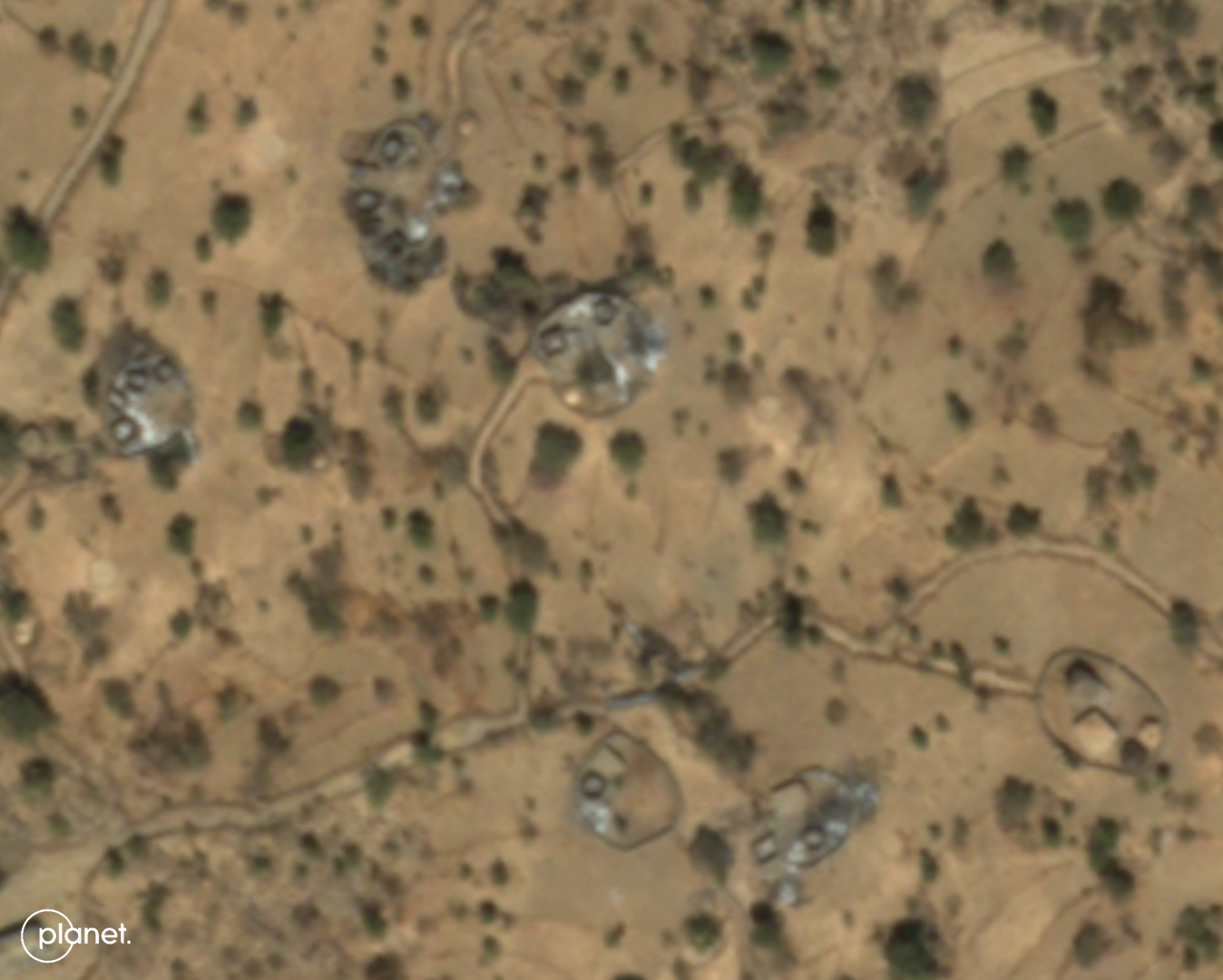
Like Debre Harmaz, the remote farming community of Adi Mendi, located three miles from Ethiopia’s border, also appears to have been destroyed. According to analysis by the DX Open Network, satellite imagery revealed that on January 19, some 478 structures, mostly tukul homes made from compressed straw, grass and mud, were set on fire. Tukul homes are common in farming communities across Ethiopia.

“Many of them were burnt alive in their homes.”

“Absence of scorching between blackened structures suggests intentional burning, not the result of a wildfire,” the DX Open Network said of the images in a statement to VICE World News. “Perpetrators likely went from structure to structure to initiate razing. And furthermore, there were no apparent indicators of any militarily valid targets.”

A SATELLITE IMAGE DEPICTING 478 STRUCTURES DESTROYED IN ADI MENDI, WITH PURPLE HIGHLIGHTING “CATASTROPHIC” DAMAGE, AND RED “EXTENSIVE DAMAGE. THE BEIGE MARKER INDICATES BILLOWING SMOKE VISIBLE A FULL DAY AFTER ATTACK. (COURTESY OF PLANETLABS INC)

“Many of them were burnt alive in their homes,” said Adamu Gidey, who hails from the nearby town of Rama and is well acquainted with the border areas. “I’ve met with survivors, who told me that the Adi Mendi is now a ghost town. Farmers were forced by Eritrean soldiers to slaughter their cows and prepare food for the soldiers. They later doused the homes of these same farmers in gasoline. Adi Mendi no longer exists.”

A SATELLITE IMAGE DEPICTING ADI MENDI’S SCORCHED TUKUL HOMES. ANALYSIS FROM DX OPEN NETWORK SAYS THAT BECAUSE THERE IS NO DAMAGE TO NEARBY TREES, IT IS A CLEAR INDICATOR OF DELIBERATE AND CALCULATED BURNINGS. (COURTESY OF PLANETLABS INC)

The satellite images of the visible scorched aftermath point to possibly thousands of people being rendered homeless or far worse.

“The people of Adi Mendi were farmers who would go once a month on hours-long treks to nearby areas to sell their produce, as there are no paved roads for vehicles,” said Gidey, whose name has been changed to protect his safety. “They didn’t deserve this cruelty.”

The DX Open Network’s analysis also confirmed that in recent weeks, the razing has begun to expand beyond central Tigray. The village of Ademeyti, located just south of the long contested town of Badme, and flashpoint of the 1998-2000 Ethiopian-Eritrean border war, was similarly ransacked, with homes set on fire as recently as February 16. DX Open Network shared satellite imagery of Ademeyti’s ruins with VICE World News.

While much of the war was fought under a communications blackout, as phone and internet services were severed from the entire area and aid workers and journalists were not allowed into the region, multiple reports this past week have echoed similar findings of ethnic cleansing and indiscriminate destruction. Yesterday, the New York Times published portions of a U.S. government report which stated that ethnic cleansing was rampant in northern Tigray. According to the report, “whole villages were severely damaged or completely erased.”

According to an Amnesty International report also published on Friday, Eritrean soldiers killed hundreds of civilians in the Tigrayan city of Axum from November 28 through November 29 in one of the worst atrocities of the war. Going door to door in the city’s residential areas, soldiers singled out males of fighting age and murdered them in their homes, the report stated.

Ethiopian soldiers are also accused of involvement in mass killings and are believed to have played a role in the systemic razing of two UNHCR run refugee camps.

For months, Ethiopia and Eritrea had denied reports that Eritrean soldiers were involved in Ethiopia’s civil war. But footage uploaded to the internet and credible reports of their involvement in atrocities led to U.S. officials calling on Eritrea to withdraw its forces. Refugees told VICE World News that they believed that Eritrea’s territorial control in Ethiopia likely extended beyond Tigray’s Maekelay district. The U.N. has echoed these concerns; chief coordinator of humanitarian efforts Mark Lowcock recently stated his belief that Ethiopian troops only controlled between 60% to 80% of Tigray, and that Eritrean soldiers operating in the area control much of the remaining areas, pursuing their own objectives independent of Ethiopian command.

“They aren’t just crossing the border, they are in control of the entire area.”

In February, on a panel organized by German news outlet Deutsche Welle, Ethiopia’s Foreign Ministry spokesperson Dina Mufti conceded that Eritrean soldiers “might have crossed into porous border areas to contain lawlessness.”

But refugees from the same border areas refute this. “They aren’t just crossing the border, they are in control of the entire area,” says Girmay, who requested he be referred to only by his first name  to protect his safety.

Girmay fled his family’s farm located in a village in the Maekelay district’s border areas after getting word that Eritrean soldiers were advancing on it. “Since the war started, we haven’t seen a single Ethiopian soldier. Only Eritreans,” he told VICE World News. “They occupy the rural areas.”

According to Girmay and four others who fled the region, the Eritrean state-run telecommunications provider Eri Tel’s network’s reach was expanded into Maekelay, meaning that unlike inhabitants of other parts of Tigray, left in the dark by the Ethiopian government’s communications shutdown, residents of the Maekelay district have been able to maintain their phone service, using Eritrean sim cards. Eritrean soldiers started to sell them, they said, after realizing the high demand.

“It’s as if we’re no longer part of Ethiopia,” he explained. “People calling you with numbers that have the +291 instead of the +251 area code, Eritrean soldiers in control of the area. But at least using the Eritrean numbers, we can warn our friends when there’s danger.”

The sudden expansion of Eritrea’s cellular network into parts of Eritrean occupied Ethiopia points is worrying, said Girmay. But he also believed it helped save lives, including his own.

Girmay says the tiny and mountainous Ethiopian village of Adi Fitaw, located two miles from the Eritrean border, was attacked twice by Eritrean raiding parties; first in mid-December and later on January 11. He told VICE World News that he fled his own home, located in a nearby village, after being warned over the phone of the second attack.

After VICE World News asked researchers from DX Open Network about this purported attack on Adi Fitaw, the organization’s researchers obtained satellite imagery from the town which they analyzed and found that approximately a dozen homes in the village were destroyed in fire-based attacks that occurred prior to January 5.

“Like the many similar attacks in rural communities, there are no apparent indicators of militarily valid targets in Adi Fitaw and there are clear indicators of the deliberate burning of homes there,” DX Open Network said.

Betre Gebreselassie hails from May Wedenberai, another village near Adi Fitaw, and currently lives in Melbourne, Australia. “Since the Eritrean phone reception started working, I’ve learned that Eritrean soldiers burnt my aunt’s home down,” he told VICE World News. “My aunt and her neighbors were lucky to escape alive. They spent weeks sleeping under trees with almost no food.”

“Like the many similar attacks in rural communities, there are no apparent indicators of militarily valid targets in Adi Fitaw and there are clear indicators of the deliberate burning of homes there.”

His family, he said, also told of other similar stories in the region. “I know of a family of parents and two children who were burnt alive in their home,” added Gebreselassie. “They enter a home, take what they like and then burn it down. They are using camels to cart off stolen possessions.”

Betre and Girmay both said that the extent of the Maekelay district’s destroyed infrastructure and deaths is unknown, but shared the names of at least a dozen separate villages which they say were razed to the ground by the Eritrean military in a manner similar to what happened at Adi Mendi.

“The Adi Mengedi, Adi Berbere, and Haftom villages were all attacked. We’ve also learned of at least 25 deaths on January 1 at Bihiza,” Girmay said. “They burnt homes and took all the cattle, camels and food as loot.”

Neither the Ethiopian Prime Minister’s press secretary, Billene Seyoum, nor Eritrean Minister of Information Yemane Gebremeskel responded to emails sent by VICE World News seeking comment on the findings. Both governments typically rebuff such allegations, with Yemane Gebremeskel only yesterday labeling Amnesty International’s report alleging Eritrean military involvement in the Axum massacre as “fallacious.”

Most of the survivors reached by VICE World News are suffering from trauma and shock, and don’t know if they will have a home to return to once the war is over.

“I think they want to kill us all,” said Samuel, whose name has been changed and who says he witnessed soldiers shoot dead his parents, three of his neighbors, and a young child. “I don’t think it would be safe to return, even if things became peaceful. They’d want to finish what they started.”

“I think they want to kill us all.”

The situation looks increasingly grim. The Ethiopian and Eritrean governments refuse to acknowledge abuses by their forces, and preventative measures don’t appear forthcoming. International pressure is also limited: While other governments have made statements condemning nearby attacks, very little has changed.

Hirut Zeray, one of over 50,000 Ethiopians to flee into Sudan, agreed. “Sudan is my country now,” she told VICE World News. “I am safe here and the people are helping us with what little they have. But in Ethiopia, we are treated worse than animals.”

https://solomonegash.com/wp-content/uploads/2023/01/snlogo.png 0 0 Solomon https://solomonegash.com/wp-content/uploads/2023/01/snlogo.png Solomon2021-02-28 13:03:092026-03-10 20:07:55VICE: Razed In Ethnic Cleansing Campaign

Amnesty: Eritrean troops’ massacre of hundreds of Axum civilians may amount to crime against humanity

February 27, 2021/0 Comments/in English, External, Politics/by Solomon

Amnesty International | 26 February 2021 |  

Amnesty International interviewed 41 survivors and witnesses to mass killings in November

  • Troops carried out extrajudicial executions, indiscriminate shelling and widespread looting
  • Satellite imagery analysis shows evidence consistent with new burial sites

Read Full Report >>>

Eritrean troops fighting in Ethiopia’s Tigray state systematically killed hundreds of unarmed civilians in the northern city of Axum on 28-29 November 2020, opening fire in the streets and conducting house-to-house raids in a massacre that may amount to a crime against humanity, Amnesty International said today in a new report.

Amnesty International spoke to 41 survivors and witnesses – including in-person interviews with recently arrived refugees in eastern Sudan and phone interviews with people in Axum – as well as 20 others with knowledge of the events. They consistently described extrajudicial executions, indiscriminate shelling and widespread looting after Ethiopian and Eritrean troops led an offensive to take control of the city amid the conflict with the Tigray People’s Liberation Front (TPLF) in mid-November.

Satellite imagery analysis by the organization’s Crisis Evidence Lab corroborates reports of indiscriminate shelling and mass looting, as well as identifies signs of new mass burials near two of the city’s churches.

“The evidence is compelling and points to a chilling conclusion. Ethiopian and Eritrean troops carried out multiple war crimes in their offensive to take control of Axum. Above and beyond that, Eritrean troops went on a rampage and systematically killed hundreds of civilians in cold blood, which appears to constitute crimes against humanity,” said Deprose Muchena, Amnesty International’s Director for East and Southern Africa.

This atrocity ranks among the worst documented so far in this conflict. Besides the soaring death toll, Axum’s residents were plunged into days of collective trauma amid violence, mourning and mass burials.

Deprose Muchena, Amnesty International’s Director for East and Southern Africa

“This atrocity ranks among the worst documented so far in this conflict. Besides the soaring death toll, Axum’s residents were plunged into days of collective trauma amid violence, mourning and mass burials.”

The mass killings came just before the annual celebration at Axum Tsion Mariam, a major Ethiopian Orthodox Christian festival on 30 November, compounding the trauma by casting a pall over an annual event that typically draws many pilgrims and tourists to the sacred city.

Large-scale military offensive

Overview image of damage & debris around the city of Axum, in Ethiopia’s Tigray region, following an offensive by Ethiopian and Eritrean forces in November 2020. Image: Google © 2021 Maxar Technologies

On 19 November 2020, Ethiopian and Eritrean military forces took control of Axum in a large-scale offensive, killing and displacing civilians with indiscriminate shelling and shooting.

In the nine days that followed, the Eritrean military engaged in widespread looting of civilian property and extrajudicial executions.

Witnesses could easily identify the Eritrean forces. They drove vehicles with Eritrean license plates, wore distinctive camouflage and footwear used by the Eritrean army and spoke Arabic or a dialect of Tigrinya not spoken in Ethiopia. Some bore the ritual facial scars of the Ben Amir, an ethnic group absent from Ethiopia. Finally, some of the soldiers made no secret of their identity; they openly told residents they were Eritrean.

‘All we could see were dead bodies and people crying’

According to witnesses, the Eritrean troops unleashed the worst of the violence on 28-29 November. The onslaught came directly after a small band of pro-TPLF militiamen attacked the soldiers’ base on Mai Koho mountain on the morning of 28 November. The militiamen were armed with rifles and supported by residents brandishing improvised weapons, including sticks, knives and stones.

Sustained gunfire can be heard ringing out across the city in a video recorded early that day from several locations at the bottom of the mountain.

A 22-year-old man who wanted to bring food to the militia told Amnesty International: “The Eritrean soldiers were trained but the young residents didn’t even know how to shoot… a lot of the [local] fighters started running away and dropped their weapons. The Eritrean soldiers came into the city and started killing randomly.”

Survivors and witnesses said Eritrean forces deliberately and wantonly shot at civilians from about 4pm onwards on 28 November.

According to residents, the victims carried no weapons and many were running away from the soldiers when they were shot. One man who hid in an unfinished building said he saw a group of six Eritrean soldiers kill a neighbour with a vehicle-mounted heavy machine-gun on the street near the Mana Hotel: “He was standing. I think he was confused. They were probably around 10 metres from him. They shot him in the head.”

I saw a lot of people dead on the street. Even my uncle’s family. Six of his family members were killed. So many people were killed.

21-year-old male resident of Axum

A 21-year-old male resident said: “I saw a lot of people dead on the street. Even my uncle’s family. Six of his family members were killed. So many people were killed.”

The killings left Axum’s streets and cobblestone plazas strewn with bodies. One man who had run out of the city returned at night after the shooting stopped. “All we could see on the streets were dead bodies and people crying,” he said.

On 29 November, Eritrean soldiers shot at anyone who tried to move the bodies of those killed.

The soldiers also continued to carry out house-to-house raids, hunting down and killing adult men, as well as some teenage boys and a smaller number of women. One man said he watched through his window and saw six men killed in the street outside his house on 29 November. He said the soldiers lined them up and shot from behind, using a light-machine gun to kill several at a time with a single bullet.

Interviewees named scores of people they knew who were killed, and Amnesty International has collected the names of more than 240 of the victims. The organization has been unable to independently verify the overall death toll, but consistent witness testimonies and corroborating evidence make it plausible that hundreds of residents were killed.

Burying the dead

Most of the burials took place on 30 November, but the process of collecting and burying the bodies lasted several days.

Many residents said they volunteered to move the bodies on carts, in batches of five to 10 at a time; one said he transported 45 bodies. Residents estimate that several hundred people were buried in the aftermath of the massacre, and they attended funerals at several churches where scores were buried. Hundreds were buried at the largest funeral, held at the complex that includes the Arba’etu Ensessa church and the Axum Tsion St Mariam Church.

Amnesty International’s Crisis Evidence Lab geolocated a video showing people carrying a dead man on a stretcher in Da’Ero Ela Plaza (14.129918, 38.717113), towards Arba’etu Ensessa church. High-resolution satellite imagery from 13 December shows disturbed earth consistent with recent graves around the Arba’etu Ensessa and the Abune Aregawi churches.

Intimidation and looting

In the days following the burials, the Eritrean army rounded up hundreds of residents in different parts of the city. They beat some of the men, threatening them with a new round of revenge killings if they resisted.

Axum residents witnessed a surge in the Eritrean army’s looting during this period, targeting stores, public buildings including a hospital, and private homes. Luxury goods and vehicles were widely looted, as well as medication, furniture, household items, food, and drink.

International humanitarian law (the laws of war) prohibits deliberate targeting of civilians, indiscriminate attacks, and pillage (looting). Violations of these rules constitute war crimes. Unlawful killings that form part of a widespread or systematic attack against a civilian population are crimes against humanity.

“As a matter of urgency, there must be a UN-led investigation into the grave violations in Axum. Those suspected of responsibility for war crimes or crimes against humanity must be prosecuted in fair trials and victims and their families must receive full reparation,” said Deprose Muchena.“We repeat our call on the Ethiopian government to grant full and unimpeded access across Tigray for humanitarian, human rights, and media organizations.”

0 0 Solomon https://solomonegash.com/wp-content/uploads/2023/01/snlogo.png Solomon2021-02-27 12:11:342026-03-10 19:31:27Amnesty: Eritrean troops’ massacre of hundreds of Axum civilians may amount to crime against humanity
Page 2 of 21‹1234›»
Popular
  • From Oslo to The Hague – The journey of Abiy Ahmed...November 7, 2020 - 3:06 pm
  • Reads Atlas Shrugged
    My top reads of 2023December 31, 2023 - 3:40 pm
  • የትግራይ ህዝብ እና የህውሓት ግኑኝነት...September 29, 2016 - 12:30 am
  • ጸበባን ቃልሲን ህዝቢ ትግራይ ከመይ...January 26, 2021 - 1:36 pm
  • ከምጽዓተ ኢትዮጵያ እንተርፍ ይሆን?...December 29, 2023 - 7:29 pm
  • Wooldridge chapter 4 – ExamplesJanuary 6, 2019 - 11:30 pm
  • IPIS Briefing March 2021 – Ethiopia-Tigray ConflictApril 10, 2021 - 7:03 pm
  • Spatial Mapping of Education DataDecember 24, 2018 - 12:01 am
  • ሶስቱ የጥፋት ፈረሶችና የኢትዮጵያ...November 12, 2020 - 5:48 pm
  • ትርጉም የለሽ ምጥ የለም!November 30, 2020 - 8:35 pm
  • መንግስት እና የህዝብ አስተዳደር –...March 5, 2017 - 2:19 am
  • በአዲስ አበባና በሌሎች ከተሞች የሚታዩ...February 8, 2019 - 3:23 pm
Recent
  • ጽምዶMarch 31, 2026 - 8:18 pm
  • ክሪቶ በፕላቶMarch 28, 2026 - 11:37 pm
  • ፍራንከንስታይን፥ አዲስ መፅሓፍ በገበያ...February 18, 2026 - 6:15 pm
  • My Top Reads of 2025December 15, 2025 - 4:31 pm
  • ሓንሳዕ ንደማመፅ እሞ!!October 18, 2025 - 6:16 pm
  • Great Ideas E04. Liberation, Then ReflectionOctober 10, 2025 - 6:54 pm
  • Great Ideas E03 – The Median Isn’t the MessageOctober 3, 2025 - 3:16 pm
  • ሃቅ ሃቁን ብቻ እናውራ ከተባለ ̷...October 1, 2025 - 11:55 pm
  • Great Ideas E02 – Great Scientific Ideas That Changed...September 26, 2025 - 1:30 pm
  • Great Ideas E01 – I, PencilSeptember 20, 2025 - 2:53 pm
  • My Replication Codes Project Gains Wider RecognitionSeptember 11, 2025 - 7:02 pm
  • Free GIS & Remote‑Sensing Toolkit 🌍April 18, 2025 - 9:18 pm
Comments
  • NATNAEL ENDALAMAW DERSHEየገብረህወት ባይከዳኝ መጥሃፍ መንግስት...November 20, 2025 - 5:40 pm by NATNAEL ENDALAMAW DERSHE
  • ሙለርትኽክል አለኻ ፀላኢኻን ፈታዊኻን ፈሊኻ...October 19, 2025 - 8:06 am by ሙለር
  • AwetThis is a very reflective essay about Tigray’s political...October 18, 2025 - 9:13 pm by Awet
  • Solomonሰላም ደረጀ ጽሁፉን እንዴት ማግኘት...April 19, 2025 - 8:32 pm by Solomon
  • ደረጀሶል የዶ/ር ተወልደ አርቲክል በሶፍት...April 19, 2025 - 7:35 pm by ደረጀ
  • Solomonእንኳዕ ሓቢሩ አብጽሓና!January 2, 2024 - 3:13 pm by Solomon
  • Solomonእንኳን አብሮ አደረሰን Babi!January 2, 2024 - 3:13 pm by Solomon
  • SolomonThank you Chombe, I wish you the same!January 2, 2024 - 3:12 pm by Solomon
  • Solomonአሰስ ብትል አንዳንዶቹን ኦንላይን...January 2, 2024 - 3:11 pm by Solomon
  • Brehaneእንኳዕ አብፅሓካ ሰሌ!January 2, 2024 - 2:46 am by Brehane
  • Babiሶል እንኳን አደረሰህ!January 1, 2024 - 7:34 am by Babi
  • ChombeThank you! All the best for 2024!December 31, 2023 - 9:03 pm by Chombe
©2026 - Solomon Negash
  • Home
  • Cons.Book
  • EthioData
  • Feeds
  • Contact
Scroll to top Scroll to top Scroll to top