ሃቅ ሃቁን ብቻ እናውራ ከተባለ …

ሃቅ ሃቁን ብቻ እናውራ ከተባለማ …
የፖለቲካ ወይም የኢኮኖሚ ፍልስፍና እይታቸውን ፈጽሞ የማልስማማበት፣ ነገር ግን በጣም የማደንቃቸው ባለ ከባድ ሚዛን አስተማሪዎቼ (ተጽእኖ ፈጣሪዎች) በምድር ላይ ሁለት ሰዎች አሉ/ነበሩ። መለስ ዜናዊ እና አያን ራንድ። የአትላስ ሽራግድ እና ዘ ፋውንቴን ሄድ ደራሲዋና ፈላስፋዋ ራንድ፣ በጆን ጋልት እና በሃዋርድ ሮርክ አማካኝነት የምታስተላልፋቸው፣ ፍጹም የማታወላዳበት የኦብጀክቲቪዝም ፍልስፍና ብላ የምትጠራው ግለሰባዊነትን እስከጥግ ድረስ ለጥጣ የምታወድስባቸው ስራዎቿ በብዙ የማልስማማባቸው (አንዳንዴ የምጸየፋቸው ጭምር) ቢሆንም፣ ብዙ የተማርኩባት እና የማደንቃት ጸሃፊ ናት። ስለ ራንድ በሌላ ጊዜ እንመለስበታለን። አሁን ስለ መለስ እናውራ።
ራሳችንን ካልዋሸን በስተቀር፣ መለስ በተለይ በኢኮኖሚክስ ትንተናው አንድን ትውልድ አነሳስቷል፣ ቀርጿል፣ ቢባል ማጋነን አይሆንም። በመለስ ዘመን ስለ ዴቨሎፕመንታል ኢኮኖሚክስ የማይደሰኩር ፖለቲከኛ፣ ምሁር፣ ተማሪ፣ ካድሬ ወዘተ አልነበረም ቢባል ማጋነን አይሆንም። ስለ ኢኮኖሚክ ፓራዳይም፣ ስለ ግሪን ኢኮኖሚ፣ ስለ ኒዮሊበራሊዝም፣ ስለ ኪራይ ሰብሳቢነት (ሬንት ሲከርስ) ወዘተ የማይወራበት፣ የማይተነተንበት እና የማይተችበት ቀን አልነበረም። በፖለቲካው ልንቃወመውና ልንጠላው እንችላለን (በዛም ረገድ ሻምፕዮን እንደነበር አሁን እየበራልን ቢሆንም)፣ በኢኮኖሚክስ እውቀቱ፣ የትንታኔ ብቃቱ፣ ከኢንግሊዝኛ ወደ አማርኛና ትግርኛ የመመለስ ብቃቱ ግን ማንም ሰው አይክደውም።
እስኪ እውነት እንናገር እና፣ ስለ ርዕዮተ አለም፣ ስለ ስኩል ኦፍ ኢኮኖሚክስ፣ ስለ ኢኮኖሚክ ፍልስፍና ከመለስ ዘመን ወዲህ በማህበራዊም በሉት በመንግስት ሚድያ ተወርቶ ያውቃል? ያ አጀንዳ፣ ያ ሙግት፣ ያ ትችት አልናፈቃችሁም? በነ ኮንፍዩዝድ እና ኮንቪንስ ዘመን፣ መደመር ከምትለው የ3ኛ ክፍል አርቲሜቲካ የዘለለ አንዲት ቃል ሳንሰማ አስር አመት ሊሞላን ደረሰ። በመለስ ዘመን ፎር ግራንትድ ወስደነው የነበረ ጸጥታ፣ የማዕከላዊ መንግስት ጥንካሬ፣ ወዘተ ከመለስ ወዲህ አፈርድሜ ግጦ፣ ወሬያችን እና ኑሯችን ሁሉ ስለ ጦርነት ብቻ አልሆነም? እንደ ዘመነ ደርግ፣ ብልጽግና እድሜዋን በጦርነት ፈጀችው። ቅቤው ኢንስፓየር ያደረገው ትውልድ ቢኖር እነ ምናምን ድሪምስ እንደሚባሉት አነቃቂ እና ሰባኪ ነን ባዮችን ብቻ ነው። (የበርትራንድ ራስል ፍልስፍና መጽሃፍ ካነበባችሁ፣ እንዲህ አይነት ሰዎች የሚበራከተቱ ከአንድ ማህበረሰብ ውድቀት እና ስብራት ብኋላ መሆኑን ትገነዘባላችሁ። ትኩረት ሁሉ ራስን ለማጽናናት፣ ቀኑን እንደምንም ለማሳለፍ ይሆናል። የስቶይሲዝም ፍልስፍናን በዚህ መልኩ ነው ሩስል የሚገልጸው። ግሪኮች በጦርነት ተሸንፈው አገራቸው እንክትክት ስትል እና በሌሎች ቁጥጥር ስር ስትወድቅ፣ ያ ሰማይ ምድሩን የቧጠጠው፣ ከአተም እስከ አጽናፈ አለም የቃኘው ፍልስፍናቸው ከስሞ በነ ኢፒኲሬስና ኢፒክቲቱስ የሃፒነስ ፍልስፍና ተተካ። አይንህን ጨፍነህ የልብ ትርታህን ካዳመጥክ፣ ጭንቀትህ ሁሉ ውልቅ ብሎ ሲሔድ ታያለህ። የደስታ ምንጭ ወደ ውስጥ መመልከት ነው። ወዘተ)
መለስ በአደባባይ ጭምር ደረቱን ነፍቶ እየተከራከረ የኢትዮጵያን ኢኮኖሚ ከኒዮሊበራላይዝም ታደገው። በየጊዜው የሚቀርብበትን ጫና ተቋቁሞ፣ ተከራክሮ፣ እነ ጆ ስቲግልቲዝ አስደምሞ፣ የኢኮኖሚ ሉኣላዊነቱን አስከብሮ አለፈ። (አገሪቱ በየጊዜው የምትቀበለውን ምጽዋት ወደጎን ብለን)። ዛሬ አንድም ሳይቀር ገበያው በሙሉ ተበርግዶ ላለው ሲሰጥ፣ አንዲትም ክርክር አልተደረገም፣ ወይ አመክንዮ አልቀረብም። እንደሾካካ የተባለቱን ፈጽመው ጭጭ አሉ። ሃሳብ የደረቀበት ስርዓት እና ዘመን ላይ ሆነህ እንደ ወ/ሮ ጊዜሽወርቅ ተሰማ በድፍረት ምስክርነትህን ስትሰጥ … ያምርብሃልና የኔን እንሆ አልኳችሁ።

VICE: Razed In Ethnic Cleansing Campaign

VICE |  Survivor testimony and satellite imagery in Ethiopia’s Tigray region provide evidence of wide-ranging destruction by Eritrean soldiers.

By Zecharias Zelalem | Feb 27 2021

“They set our crops on fire, then they started burning the homes,” said Gebru Habtom, a farmer in his 40s from the village of Debre Harmaz in Ethiopia. “Then they said they’d burn me next, so I fled for my life.”

Gebru, whose name has been changed to protect him from reprisals, was born and raised in the village of Debre Harmaz in central Tigray, some five miles from Ethiopia’s border with Eritrea. Like thousands of others, he has been displaced by Ethiopia’s months-long civil war.

Gebru connected with VICE World News from an undisclosed location along the Ethiopian-Sudanese border, and said that there was no sign of war or even resistance fighters present when, on January 10, Eritrean soldiers arrived in his village and went on a murderous rampage, pillaging and setting homes alight. “They shot at everyone, they even killed priests who were hiding in the church,” he said. Gebru also said that he heard about neighboring villages experiencing similar destruction that has also gone unreported.

“They shot at everyone, they even killed priests who were hiding in the church.”

Over the past month, VICE World News has documented harrowing testimony from nine displaced Tigrayans who recalled wanton slaughter, the destruction of crops and livelihoods, and tens of thousands fleeing from areas of Ethiopia’s Tigray region under Eritrean military control. Their testimony has been largely confirmed by satellite image analysis by the U.K.-based research organization DX Open Network, and their recounting and the image analysis both suggest that Eritrean soldiers involved in Ethiopia’s war in Tigray are ethnically cleansing communities near the Ethiopian-Eritrean border.

While several towns in the area have been previously reported destroyed, VICE World News found that, at minimum, an additional four villages in Tigray have likely been razed, and their inhabitants killed.

Eritrean soldiers first entered Ethiopia’s civil war to fight alongside the Ethiopian army against forces of Tigrayan People’s Liberation Front, known as TPLF, or the governing party in the region. In November, soldiers from the two countries succeeded in jointly pushing out Tigrayan forces from the regional capital, Mekelle, and have been accused by international organizations like Amnesty International and Human Rights Watch of brutal war crimes and indiscriminate shelling that targeted civilians and is believed to have left thousands dead.

Residents say that though Ethiopian prime minister Abiy Ahmed declared victory and the end of combat operations, Eritrean military units have continued attacking civilian areas, looting and killing before setting properties ablaze to render entire areas uninhabitable.

Now, Ethiopia claims it is conducting clean-up operations across parts of rural Tigray. Satellite imagery from central Tigray’s Eritrean border, however, points to something far more nefarious.

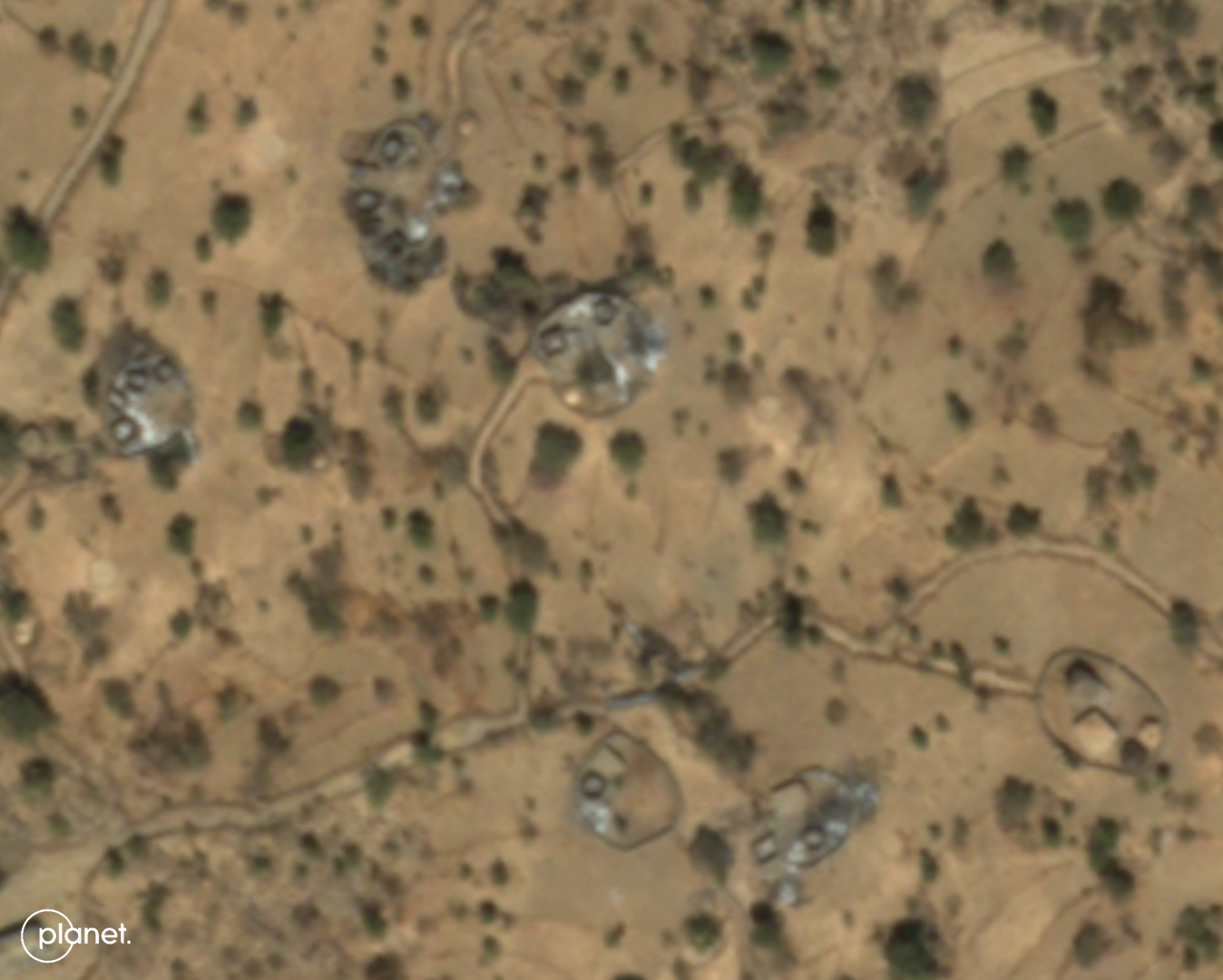
Like Debre Harmaz, the remote farming community of Adi Mendi, located three miles from Ethiopia’s border, also appears to have been destroyed. According to analysis by the DX Open Network, satellite imagery revealed that on January 19, some 478 structures, mostly tukul homes made from compressed straw, grass and mud, were set on fire. Tukul homes are common in farming communities across Ethiopia.

“Many of them were burnt alive in their homes.”

“Absence of scorching between blackened structures suggests intentional burning, not the result of a wildfire,” the DX Open Network said of the images in a statement to VICE World News. “Perpetrators likely went from structure to structure to initiate razing. And furthermore, there were no apparent indicators of any militarily valid targets.”

A SATELLITE IMAGE DEPICTING 478 STRUCTURES DESTROYED IN ADI MENDI, WITH PURPLE HIGHLIGHTING “CATASTROPHIC” DAMAGE, AND RED “EXTENSIVE DAMAGE. THE BEIGE MARKER INDICATES BILLOWING SMOKE VISIBLE A FULL DAY AFTER ATTACK. (COURTESY OF PLANETLABS INC)

“Many of them were burnt alive in their homes,” said Adamu Gidey, who hails from the nearby town of Rama and is well acquainted with the border areas. “I’ve met with survivors, who told me that the Adi Mendi is now a ghost town. Farmers were forced by Eritrean soldiers to slaughter their cows and prepare food for the soldiers. They later doused the homes of these same farmers in gasoline. Adi Mendi no longer exists.”

A SATELLITE IMAGE DEPICTING ADI MENDI’S SCORCHED TUKUL HOMES. ANALYSIS FROM DX OPEN NETWORK SAYS THAT BECAUSE THERE IS NO DAMAGE TO NEARBY TREES, IT IS A CLEAR INDICATOR OF DELIBERATE AND CALCULATED BURNINGS. (COURTESY OF PLANETLABS INC)

The satellite images of the visible scorched aftermath point to possibly thousands of people being rendered homeless or far worse.

“The people of Adi Mendi were farmers who would go once a month on hours-long treks to nearby areas to sell their produce, as there are no paved roads for vehicles,” said Gidey, whose name has been changed to protect his safety. “They didn’t deserve this cruelty.”

The DX Open Network’s analysis also confirmed that in recent weeks, the razing has begun to expand beyond central Tigray. The village of Ademeyti, located just south of the long contested town of Badme, and flashpoint of the 1998-2000 Ethiopian-Eritrean border war, was similarly ransacked, with homes set on fire as recently as February 16. DX Open Network shared satellite imagery of Ademeyti’s ruins with VICE World News.

While much of the war was fought under a communications blackout, as phone and internet services were severed from the entire area and aid workers and journalists were not allowed into the region, multiple reports this past week have echoed similar findings of ethnic cleansing and indiscriminate destruction. Yesterday, the New York Times published portions of a U.S. government report which stated that ethnic cleansing was rampant in northern Tigray. According to the report, “whole villages were severely damaged or completely erased.”

According to an Amnesty International report also published on Friday, Eritrean soldiers killed hundreds of civilians in the Tigrayan city of Axum from November 28 through November 29 in one of the worst atrocities of the war. Going door to door in the city’s residential areas, soldiers singled out males of fighting age and murdered them in their homes, the report stated.

Ethiopian soldiers are also accused of involvement in mass killings and are believed to have played a role in the systemic razing of two UNHCR run refugee camps.

For months, Ethiopia and Eritrea had denied reports that Eritrean soldiers were involved in Ethiopia’s civil war. But footage uploaded to the internet and credible reports of their involvement in atrocities led to U.S. officials calling on Eritrea to withdraw its forces. Refugees told VICE World News that they believed that Eritrea’s territorial control in Ethiopia likely extended beyond Tigray’s Maekelay district. The U.N. has echoed these concerns; chief coordinator of humanitarian efforts Mark Lowcock recently stated his belief that Ethiopian troops only controlled between 60% to 80% of Tigray, and that Eritrean soldiers operating in the area control much of the remaining areas, pursuing their own objectives independent of Ethiopian command.

“They aren’t just crossing the border, they are in control of the entire area.”

In February, on a panel organized by German news outlet Deutsche Welle, Ethiopia’s Foreign Ministry spokesperson Dina Mufti conceded that Eritrean soldiers “might have crossed into porous border areas to contain lawlessness.”

But refugees from the same border areas refute this. “They aren’t just crossing the border, they are in control of the entire area,” says Girmay, who requested he be referred to only by his first name  to protect his safety.

Girmay fled his family’s farm located in a village in the Maekelay district’s border areas after getting word that Eritrean soldiers were advancing on it. “Since the war started, we haven’t seen a single Ethiopian soldier. Only Eritreans,” he told VICE World News. “They occupy the rural areas.”

According to Girmay and four others who fled the region, the Eritrean state-run telecommunications provider Eri Tel’s network’s reach was expanded into Maekelay, meaning that unlike inhabitants of other parts of Tigray, left in the dark by the Ethiopian government’s communications shutdown, residents of the Maekelay district have been able to maintain their phone service, using Eritrean sim cards. Eritrean soldiers started to sell them, they said, after realizing the high demand.

“It’s as if we’re no longer part of Ethiopia,” he explained. “People calling you with numbers that have the +291 instead of the +251 area code, Eritrean soldiers in control of the area. But at least using the Eritrean numbers, we can warn our friends when there’s danger.”

The sudden expansion of Eritrea’s cellular network into parts of Eritrean occupied Ethiopia points is worrying, said Girmay. But he also believed it helped save lives, including his own.

Girmay says the tiny and mountainous Ethiopian village of Adi Fitaw, located two miles from the Eritrean border, was attacked twice by Eritrean raiding parties; first in mid-December and later on January 11. He told VICE World News that he fled his own home, located in a nearby village, after being warned over the phone of the second attack.

After VICE World News asked researchers from DX Open Network about this purported attack on Adi Fitaw, the organization’s researchers obtained satellite imagery from the town which they analyzed and found that approximately a dozen homes in the village were destroyed in fire-based attacks that occurred prior to January 5.

“Like the many similar attacks in rural communities, there are no apparent indicators of militarily valid targets in Adi Fitaw and there are clear indicators of the deliberate burning of homes there,” DX Open Network said.

Betre Gebreselassie hails from May Wedenberai, another village near Adi Fitaw, and currently lives in Melbourne, Australia. “Since the Eritrean phone reception started working, I’ve learned that Eritrean soldiers burnt my aunt’s home down,” he told VICE World News. “My aunt and her neighbors were lucky to escape alive. They spent weeks sleeping under trees with almost no food.”

“Like the many similar attacks in rural communities, there are no apparent indicators of militarily valid targets in Adi Fitaw and there are clear indicators of the deliberate burning of homes there.”

His family, he said, also told of other similar stories in the region. “I know of a family of parents and two children who were burnt alive in their home,” added Gebreselassie. “They enter a home, take what they like and then burn it down. They are using camels to cart off stolen possessions.”

Betre and Girmay both said that the extent of the Maekelay district’s destroyed infrastructure and deaths is unknown, but shared the names of at least a dozen separate villages which they say were razed to the ground by the Eritrean military in a manner similar to what happened at Adi Mendi.

“The Adi Mengedi, Adi Berbere, and Haftom villages were all attacked. We’ve also learned of at least 25 deaths on January 1 at Bihiza,” Girmay said. “They burnt homes and took all the cattle, camels and food as loot.”

Neither the Ethiopian Prime Minister’s press secretary, Billene Seyoum, nor Eritrean Minister of Information Yemane Gebremeskel responded to emails sent by VICE World News seeking comment on the findings. Both governments typically rebuff such allegations, with Yemane Gebremeskel only yesterday labeling Amnesty International’s report alleging Eritrean military involvement in the Axum massacre as “fallacious.

Most of the survivors reached by VICE World News are suffering from trauma and shock, and don’t know if they will have a home to return to once the war is over.

“I think they want to kill us all,” said Samuel, whose name has been changed and who says he witnessed soldiers shoot dead his parents, three of his neighbors, and a young child. “I don’t think it would be safe to return, even if things became peaceful. They’d want to finish what they started.”

“I think they want to kill us all.”

The situation looks increasingly grim. The Ethiopian and Eritrean governments refuse to acknowledge abuses by their forces, and preventative measures don’t appear forthcoming. International pressure is also limited: While other governments have made statements condemning nearby attacks, very little has changed.

Hirut Zeray, one of over 50,000 Ethiopians to flee into Sudan, agreed. “Sudan is my country now,” she told VICE World News. “I am safe here and the people are helping us with what little they have. But in Ethiopia, we are treated worse than animals.”

How to Stop Ethnic Nationalism From Tearing Ethiopia Apart

Foreign Policy | The 1994 Ethiopian Constitution celebrated self-determination, but it laid the groundwork for today’s violence. Devolution could offer a way out.

On Nov. 28, 2020, Ethiopia’s military took control of Mekele, the capital of Tigray region, after a monthlong fight with the Tigray People’s Liberation Front (TPLF).

Before the conflict, the Tigray region under TPLF rule was edging toward de facto independence. After the TPLF lost its hegemonic position in Addis Ababa in 2015—where it had dominated Ethiopia’s ruling coalition for decades—it relocated political and bureaucratic personnel to Mekele. When national elections were postponed due to COVID-19, the TPLF rejected the constitutionality of the decision and went ahead with its own regional election, which it won handily.

Then, it declared that it no longer recognized the federal government as legitimate, and it successfully thwarted the appointment of a new head to the Ethiopian army’s Northern Command, effectively apportioning to itself the most heavily armed section of the National Defense Force. This was followed by a coordinated, preemptive attack on the Ethiopian army’s Northern Command in the early hours of Nov. 4 that enabled the TPLF to take control of the army headquarters in Mekele and several other bases. Prime Minister Abiy Ahmed quickly appeared on TV to launch a military operation to dislodge the TPLF from Tigray.

The conflict in Tigray is not merely a political squabble between the TPLF and Abiy’s Prosperity Party, but a struggle for sovereignty between the federal government and a regional state. This is also not the first time the federal government went to war to reclaim control of an intransigent regional state. In August 2018, the federal government undertook an armed operation to dislodge Abdi Mohamoud Omar (also known as Abdi Ilay), the then-president of the Somali regional state—leading to many deaths and the displacement of civilians, especially ethnic minorities.

Ethnic federalism has made Ethiopia a more fragmented, polarized, and conflict-plagued country.

Ethiopia’s constitution, which was ratified in 1994 under the auspices of the Ethiopian People’s Revolutionary Democratic Front, which was dominated by the TPLF, is unique in endowing sovereignty upon the country’s nations and nationalities. Its position is also radical because it allows an unqualified right for self-determination, up to secession, to Ethiopia’s more than 80 ethnic groups. This has raised the stakes in federal-regional disagreements, and potentially increased the risk of conflict by allowing secession to be a bargaining chip in political disputes.

For its supporters, the ethnic-based federal system represents a triumph for the age-old quest of Ethiopia’s disenfranchised ethnic groups for autonomy and self-rule. The federal system is seen as the answer to the “question of nations and nationalities”—a school of political thought that critiqued and rejected sociopolitical domination by Ethiopia’s northern Christian elites, mainly ethnic Amharas and, to a lesser degree, Tigrayans. Ethnic federalism was intended to create a new dispensation that ensured that the political, cultural, and economic rights of all ethnic and religious groups are equally respected.

But the turmoil of the past few years has also exposed the limits of Ethiopia’s experimentation in ethnic federalism. Even its ardent supporters cannot conceivably deny that ethnic federalism has raised as many questions as it has answered, and that it has made Ethiopia a more fragmented, polarized, and conflict-plagued country.

The endorsement of the Marxist-Leninist notion of self-determination in Ethiopia’s constitution was all the more puzzling in light of historical developments at the time of its inception. In the early 1990s, just as Ethiopia’s constitution was being drafted, the Soviet Union and Yugoslavia—two federations that had enshrined ethnic self-determination in their respective constitutions—were going through violent episodes of disintegration.

The TPLF and other architects of Ethiopia’s constitution could not have missed the ominous signs on open display; They most likely considered their own country’s eventual breakdown as an acceptable, perhaps even desirable, outcome. The bloody dissolution of Yugoslavia, which was attended by bitter interethnic wars, was also a red flag for what self-determination could entail in a multiethnic mosaic like Ethiopia. It was already clear from the 1984 national census that only 30 of Ethiopia’s 580 woredas (districts) at the time were actually monolingual ethnic islands.

In reality ethnic identities are fluid and overlaid, and ethnic territorial jurisdictions are often overlapping and contested.

The constitution’s endorsement of the right to self-determination is based on the contentious supposition that ethnic groups can be neatly subdivided into mutually exclusive categories, each with a claim to a distinct territorial homeland. In reality ethnic identities are fluid and overlaid, and ethnic territorial jurisdictions are often overlapping and contested.

Even in Tigray, the only regional state that nominally existed before the current constitution, regional boundaries were entirely redrawn upon the creation of new administrative units in 1994. Much of the current West Tigray and North West Tigray zones (Welkait, Humera, Tsegede, and Tselemte) and some parts of South Tigray (Raya Azebo) were apportioned from the former provinces of Gondar and Wollo, which were mainly inhabited by Amharas.

These territories, which roughly make up one-third of present-day Tigray, are vigorously contested by Amhara nationalists as their own—a dispute that contributed to the involvement of the region’s special forces in the recent war in Tigray. Had Tigray under the TPLF proceeded with secession, it would have only been a matter of time before it descended into an intractable border war with the rest of Ethiopia, just as Eritrea did after winning its own de facto independence in 1991, which was formalized through a referendum in 1993.

The 1998-2000 Eritrean-Ethiopian border war, which led to the death of more than 100,000 people from both sides, helped entrench the TPLF’s rule in Ethiopia, but it also severely weakened Eritrea, sowing the seeds of a deep-seated animosity between the TPLF and Isaias Afwerki, Eritrea’s authoritarian president. At the peak of the Tigray conflict in November 2020, the TPLF fired a series of rockets at the capital of Eritrea, accusing it of sending in its army to Tigray, an allegation that Eritrea denies but is supported by recent independent reports.

One of the most devastating effects of Ethiopia’s ethnic federalism is its utter failure to protect minorities. For instance, the 1994 constitution created a new region called Benishangul-Gumuz as one of Ethiopia’s nine (now 10) administrative regional states, as a homeland to the Benishangul and Gumuz ethnic groups. The region’s constitution affirms that the region “belongs” to five native ethnic groups: the Berta, Gumuz, Shinasha, Mao, and Komo. Other important minorities like Amharas, Oromos, and Agaws, who make up at least 40 percent of the region’s population, are treated as second-class citizens without a right to create their own (ethnic) parties for legitimate political representation.

The failure to safeguard minorities extends to all regional states, leaving minorities in a precarious situation where they live with a constant fear of eviction. A narrative of “natives” versus “outsiders” and a political discourse grounded in ethnic grievances inevitably feeds into cycles of violence. In times of political change and instability, such as the period since 2015, ethnic tensions have boiled over, making minorities victims of brutal killing, eviction, and displacement.

The number of these incidents is despairingly too great to count but includes recent episodes where Amharas were displaced by the thousands in Oromia, Oromos were displaced from Somali region, Tigrayans were violently evicted from Amhara region, as well as a perpetual violence in Benishangul-Gumuz region that has brought death and destruction to hundreds from all ethnic groups. These tragic events have not only traumatized millions but also frayed the tender threads of trust and social capital that have held communities together for centuries.

Moreover, in its fixation on ethnic autonomy, the current constitution has severely impaired, perhaps intentionally, the political power of urban centers—which are ethnic melting pots and thus do not fit the ideological straitjacket of ethnic purity. Since the constitution defines land as a property of ethnic groups, cities without a specific ethnic identity have been left without land, and hence without a right to statehood.

The capital, Addis Ababa—despite being the economic and political hub of the country with far greater population that four of the original nine regional states—is constituted as a federally administered enclave that, according to the constitution, is located “within the State of Oromia.” In a country where ethnic identity has become the most fundamental variable of political and economic organization, multiethnic urban centers like Addis Ababa and Dire Dawa are reduced to being staging grounds of political influence among competing ethnic parties rather than being able to administer themselves.

The experiment in ethnic federalism has led to the formation of powerful, militarized, ethnic regional states that harbor old grievances against one another, along with unresolved border disputes that could ignite conflicts at any time. Unless the power of these regional administrations is checked proactively, there is tangible risk that they could be drawn into devastating conflicts that will wreak havoc not only in Ethiopia, but also in neighboring countries, each of which shares at least one ethnic group with Ethiopia.

Boundary disputes between ethnic regions are hard to resolve, because almost all ethnic boundaries are artificial concoctions that lack historical precedents. Prior to the creation of these boundaries in 1994, Ethiopia’s many dozens of ethnic groups seldom had administrative boundaries entirely based on ethnic affiliation. Administrative boundaries were typically porous as people freely moved across geographies, especially in the lowlands, where people followed a mobile, nomadic lifestyle. None of the regional states of the federation existed in their current form and many, such as Amhara and Oromia regions, ever historically existed as separate, independent entities, within Ethiopia or outside. The top-down manufacturing of ethnic nations, complete with sovereign territorial boundaries, has begotten simmering border disputes that threaten to plunge the country into a civil war.

Even from the perspective of ethnic rights, the current system has not enabled the majority of the country’s ethnic groups to exercise the right to self-rule. An arbitrary nomenclature of ethnic classes has been used to allow certain ethnic groups to be organized as autonomous regional states, while denying the same right to other groups of similar population size.

The current system has not enabled the majority of the country’s ethnic groups to exercise the right to self-rule.

The constitution, for example, lumped together around 20 million people of no less than 50 ethnic groups within a region called Southern Nations, Nationalities, and Peoples’ Region (SNNP), while allowing the creation of a Harari regional state in Harar City, with a population of less than 300,000. Hararis were accorded statehood despite making up only 9 percent of the population, purportedly in recognition of the unique historical and religious significance of the city of Harar, which is fully encircled by Oromia, a massive region with close to 40 million inhabitants. These size differences create asymmetric power relations among competing administrative polities and the associated political entities that administer them, leading to political, administrative, and economic imbalances.

A highly exclusionary ethnonationalism will create persistent risks of volatility and violence, which could undermine democracy by making authoritarian positions more palatable on the grounds of peace and security. It also creates the risk of major ethnic groups—the Amhara and the Oromo—forming alliances that co-opt smaller ethnic groups, leading to a political settlement that is neither inclusive nor progressive.

It is clear that Ethiopia’s ethnic federalism needs a major overhaul in order to sustain a peaceful electoral democracy. Without a reform, the system remains a risk to itself and the country, as ethnic rivalries could easily descend into cycles of violence that will endlessly repeat the traumatic experience of the past five years.

Fixing Ethiopia’s broken federal system will require a constitutional reform that establishes new checks and balances to mitigate the risk of ethnic politics exploding into downright violence. One potential approach would be a referendum on political devolution that elevates administrative zones to the level of administrative states, thus replacing regions. Zones, which are currently the second-tier administrative units after regions, are typically inhabited by a distinct majority ethnic group.

The elevation of zones to state-level members of the federation can ensure ethnic self-administration, which would be in keeping with the constitutional emphasis on autonomy and self-rule. At the same time, it would significantly reduce the likelihood of major military or political clashes between neighboring regions, and between regions and the federal government. It would also lead to zonal states that are relatively uniform in size, facilitating a more fair and equitable sharing of political and other forms of power across them.

More importantly, having zonal states as main administrative units would be a significant step toward ensuring self-rule among dozens of nations and nationalities. This solution would, for example, automatically resolve the contention in SNNP, where Wolayta Zone and 10 other ethnic zones are demanding the right to statehood. It will also put to rest many territorial disputes including the ones over Welkait, Humera, Tsegede, Tselemte, and Raya, in which the Amhara and Tigray regional states are pitted against each other.

Ethiopia has more than 60 zones, and having so many first-tier administrative units can introduce many administrative challenges. This, however, is a technicality that can be resolved through procedural mechanisms. Kenya, for example, has adopted 47 counties as its major administrative units after a constitutional change that was enacted following the 2007 post-election violence. The devolution of administrative power to county governments has improved governance quality and given more voice and power to citizens. A Council of Governors, comprising the administrative heads of the 47 counties, coordinates collective action over issues that cut across counties.

Political devolution does not have to lead to the dissolution of the current regional states.

This political devolution does not have to lead to the dissolution of the current regional states. The regions, which can be seen as collective associations of major ethnic groups, can be reformed to serve as traditional, cultural entities charged with cultural stewardship and the pursuit of interethnic harmony.

Many African nations have similar traditional structures parallel to formal political structures. For example, Nigeria and Ghana each have dozens of traditional chiefdoms and kingdoms that do not have official political power but wield considerable influence as stewards of traditional ethnic cultures. If supported by proper governance mechanisms, the presence of parallel administrative structures could enrich and promote cultural interaction, reducing the risk of interethnic political conflict. It can also help redefine the meaning of ethnic “territorial homeland” to its cultural rather than political connotation, reducing the risk of border friction between ethnic groups as well as the disenfranchisement of minorities.

The violent end of the TPLF-dominated era has demonstrated the perils of organizing political power along ethnic lines. The episode also presents an opportunity to rethink Ethiopia’s political system and remake it to accommodate competitive politics. Without reform, Ethiopia’s ethnic federalism holds the seeds of endless conflict that will undermine the country’s very existence.

Devolution of political power to zonal states could offer a path out of the current conundrum and reduce the risk of a catastrophic conflict among militarized ethnic regional states. If approved at the ballot box and executed effectively, such a change can help usher in a democratic system in which the rights of individuals and ethnicities are balanced. It could also lead to a more sober, secular, and constructive political discourse that focuses on building communities rather than tearing them apart.

The UN Must Intervene in Tigray

Project Syndicate | Mehari Taddele Maru | When a state fails to prevent or alleviate atrocities within its territory, or if the state itself is the primary perpetrator of such acts, the UN must not stand idly by. There are five reasons why immediate action by the Security Council regarding Ethiopia’s northern region is necessary.

FLORENCE – In a recent interview, Rwandan President Paul Kagame argued that US President Joe Biden’s new administration and the United Nations Security Council should take the lead in addressing the violence and deprivation in Ethiopia’s Tigray region. . Kagame described the situation there as worrying, and said the death toll was too high for the conflict to be left only to Ethiopia or the African Union to manage. As the president of a country that is still dealing with the consequences of the 1994 genocide against its Tutsi population, Kagame speaks with considerable authority here, and deserves to be heard.

There are five reasons why immediate action by the Security Council regarding Tigray is necessary.

First, the likely presence of Eritrean armed forces in Tigray makes the war both a civil and international conflict, and hence within the UN’s remit. Eritrean troops have been implicated in killings and in the forcible return of Eritrean refugees, including through the burning of the Shimelba and Hitsats refugee camps. Some 15,000-20,000 Eritrean refugees are missing, according to the UN High Commissioner for Refugees.

Second, the Tigray region is now facing a possible famine, with 2.3 million people in need of emergency aid. The UN Office for the Coordination of Humanitarian Affairs reports that 4.5 million people – 67% of the region’s population – need assistance. Ethiopian federal government forces are said to be obstructing access to aid and clean water. There are also reports of the deliberate destruction of UN food stores and markets.

Third, with up to two million people now internally displaced, Tigray poses a significant burden on the world’s humanitarian resources at a time when the need for them in East Africa has never been higher, owing to COVID-19, locust infestation, and food insecurity. The Ethiopian government’s apparent unwillingness to allow the international community to provide rapid, unconditional, unfettered, and sustained humanitarian access to all parts of Tigray has worsened a dire situation.

Fourth, some UN reports and those of other organizations in Tigray point to possible grave breaches of the Geneva Conventions and other aspects of international humanitarian law that prohibit starvation of civilians and collective punishment. There are also reports of what may constitute state-led ethnic cleansing and genocide, as well as a “high number of alleged rapes.” Tens of thousands of Tigrayans serving in Ethiopia’s peacekeeping, security, military, police, and intelligence spheres have been dismissed from their jobs and sometimes detained.

Fifth, Ethiopia is so consumed by the fighting in Tigray that it is no longer a source of regional stability, and appears to be renouncing its role as regional peacekeeper. Security tensions and border disputes are mushrooming in the region, mainly between Ethiopia and Sudan, Kenya, and Somalia, with an election-related crisis in Somalia and negotiations over the Grand Ethiopian Renaissance Dam increasing the risk of proxy wars. The fragile political transition in Sudan also may be destabilized.

Making matters worse, the withdrawal of Ethiopian forces from peacekeeping missions in Somalia, South Sudan, and Sudan seems almost certain to increase instability. In particular, Ethiopian troops’ departure from Somalia, where the AU has conducted its AMISOM peacekeeping mission, could create an opening for the al-Qaeda-linked Al Shabaab to stage a comeback in that country.

When a state fails to prevent or alleviate atrocities within its territory (such as genocide, crimes against humanity, or war crimes), or if the state itself is the primary perpetrator of such acts, the UN must not stand idly by. After all, only the Security Council can successfully challenge a government’s deliberate obstruction of humanitarian aid.

For these reasons, the Security Council must address the situation in Tigray immediately. It should adopt a resolution aimed at alleviating the suffering in the region through determined international action, and at convincing the Ethiopian government to restore peace there.

Concretely, the resolution should establish a monitoring and verification commission with a mandate to negotiate, observe, monitor, verify, and report on conditions in Tigray. The goals should be the immediate and definitive cessation of hostilities; rapid, unconditional, unfettered, and sustained distribution of aid to all parts of Tigray; the complete withdrawal of any and all external armed forces and groups; and a ceasefire agreement that can lead to a peaceful resolution of the conflict in Tigray.

Ethiopia’s government says that it is ready to work with the international community to ease the suffering in Tigray. That promise must now be put to the test.

Ethiopia’s Abiy Ahmed goes from flying start to a quicksand of troubles

The National News | Prime minister faces civil war, ethnic divisions and simmering disputes with neighbours.

For Ethiopia’s Prime Minister Abiy Ahmed, the promise and optimism he projected when he took the reins in the Horn of Africa nation three years ago must have become a fading memory.

Those expectations have been replaced by a civil war, widening ethnic schisms and a growing crisis with neighbouring Sudan and fellow Nile basin nation Egypt.

Since winning the 2019 Nobel Peace Prize after forging peace with arch-enemy Eritrea in his first year in office, the prime minister has gone from being his country’s beacon of hope for unity and economic prosperity to a leader who shows little tolerance for dissent.

Significantly, Ethiopia’s woes and Mr Abiy’s own political predicament cast a dark shadow on the Horn of Africa and beyond.

“The high expectations of 2018 have proved to be misplaced,” said William Davison, the leading Ethiopia expert at the International Crisis Group, a conflict-prevention organisation headquartered in Brussels.

“Everything that’s happening now demonstrates that hopes for a smooth transition to peaceful multi-party democracy were naive.”

Unrest in Ethiopia – at about 110 million people the second most populous African nation – could force millions to flee their homes and take refuge in neighbouring nations.

Addis Ababa also hosts the headquarters of the African Union and the country is among Africa’s largest contributors of peacekeepers. Some of its population share the same ethnic background with cousins in countries like South Sudan and Somalia.

With a burgeoning economy and the potential to export cheap electricity from its nearly completed Grand Ethiopian Renaissance Dam on the Nile, Ethiopia has been viewed as a future engine for growth in the Horn of Africa and beyond.

Of all its troubles, the war between federal forces and separatist rebels in the northern Tigray region is by far the most worrisome.

Besides the financial and human cost of a full-fledged military operation raging there since November, the reported involvement of government-sanctioned militias from the powerful Amhara group threatens to deepen ethnic schisms and extend the conflict beyond Ethiopia’s borders.

The militias are believed to have wrested control of areas of Tigray they claim to historically belong to the Amhara.

There are also indications that forces from neighbouring Eritrea, a longtime enemy of Tigrayans, are fighting on the side of the government, something that could only perpetuate the conflict in Tigray, according to analysts.

There are credible reports of systematic atrocities and looting of heritage sites in the Tigray conflict committed by all parties, analysts said.

“Abiy has been undone by the Tigray conflict and he has administered brutal suppression of Tigrayans and brought the Amhara there to be their overlords,” said Gihad Auda, a political science professor at Cairo’s Helwan university.

The conflict in Tigray and the participation of the Amhara in the fighting have also inflamed a border crisis between Ethiopia and Sudan, which moved in December to regain control of some of its territory which had been settled by Amhara farmers for decades.

The Sudanese military’s operations in the area triggered deadly clashes with Ethiopian forces and allied militias, including mortar shelling and cross-border raids. The latest of these clashes took place on Thursday when one Sudanese soldier was killed and eight others were wounded, according to the Sudanese military.

The areas of Tigray seized by Amhara militias border Sudan, raising the likelihood of further clashes. Moreover, Ethiopia insisted that it will not negotiate on resolving the border crisis before Sudan pulls its troops from the areas retaken from Amhara farmers, a position rejected by Sudan.

Tensions between the neighbours have already been raised by the long-simmering dispute over Ethiopia’s new dam, located less than 20 kilometres from the Sudanese border.

Sudan wants Ethiopia to enter into a legally binding deal to share information and data on the operation of the dam to prevent flooding and the disruption of its own power-generating dams on the Blue Nile. Ethiopia will agree only to non-binding recommendations.

The dispute over the dam also involves downstream Egypt, which is alarmed by the possibility that the giant structure would significantly reduce its vital share of the Nile waters.

On the other hand, the dam has become a rare rallying point for Ethiopians, making it impossible for Mr Abiy to offer compromises on its operation to the Egyptians and Sudanese, according to the analysts.

“Ethiopia’s problems are converging in a negative way with its neighbours,” said Michael Hanna of the Century Foundation in New York.

“Facts on the ground are facts on the ground and neither Egypt nor Sudan can do anything about it. Time is on Ethiopia’s side since 2011 [when construction of the dam began] but its internal issues are complicating efforts to resolve the dispute over the dam and other issues.”

In all likelihood, according to Mr Davison, Mr Abiy’s party will retain power following elections scheduled for June, but that is unlikely to narrow Ethiopia’s domestic fault lines.

“For that, the country needs to embark on a comprehensive and inclusive national dialogue to try and come to terms with the past and chart a more harmonious way forward.”

In Ethiopia’s digital battle over the Tigray region, facts are casualties

The Washingtonpost | Alexi Drew and Claire Wilmot | Claims about disinformation may be undermining online activism.

Nearly three months have passed since the conflict between the Ethiopian government and the Tigray People’s Liberation Front (TPLF) began. Despite Prime Minister Abiy Ahmed’s assurance that the military operation ended in late November, the conflict in Tigray is far from over. U.N. officials this week cited reports that Ethiopian troops may not have the region under their command, and warned of grave food shortages, calling for the government to allow aid workers to enter the region.

On social media, pro- and anti-government groups continue to vie for control of the conflict narrative. Abiy released a statement on Feb. 2 encouraging Ethiopians to launch an offensive against the TPLF’s distortions and “lies” in the international arena. Our analysis of over 500,000 tweets related to Tigray helps explain the intensifying information conflict.

We collected and analyzed tweets between Nov. 4 and Jan. 20 to try to understand the kinds of information being circulated, and the effects of different messaging campaigns. We found that both sides are quick to accuse the other of spreading intentionally false information — though actual disinformation accounts for a surprisingly small proportion of tweets about the conflict.

Ethiopia’s conflict continues online

Knowing what’s really going on in Tigray’s conflict is difficult, given a communications blackout in much of the region. The government has also not allowed humanitarian access to areas that reportedly have experienced atrocities or are in urgent need of assistance. It is in this opaque information environment that people have taken to Twitter.

Pro-Tigray activism online

#StandWithTigray is a central source of activism for pro-Tigray campaigns. Its website shares instructions for using Twitter, along with pre-written content for followers to share. Their online presence can broadly be divided into three categories: “old” and “new” activist accounts; and accounts with opaque credentials.

“Old” activist accounts are largely based in Ethiopia, Europe and North America. Although their activism does not necessarily predate the conflict, their Twitter accounts often do. They demonstrate a high degree of digital literacy, posting lots of original content and engaging with other users.

“New” activist accounts were created throughout the conflict. We found over 3,000 such accounts between November and the end of January. These accounts demonstrate a low level of digital literacy, few followers and short-term engagement.

Accounts with opaque credentials claim expertise or positions aimed at boosting their credibility. They claim to be academics or aid workers but have little or no online presence beyond Twitter, making their credentials difficult to verify. These accounts may be problematic because they can obtain significant “reach” based on unsubstantiated claims.

Do these tweets contain disinformation and misinformation?

Our analysis showed that the majority of content produced by the #StandWithTigray campaign is digital activism, which seeks to raise international awareness about the conflict. The #StandwithTigray campaign is organized similarly to many other social justice campaigns on social media. Pre-written tweets build momentum around hashtags and connect to potential influencers like foreign officials, U.N. agencies or foreign ministries. This is a standard approach for activists, who usually don’t have the resources to employ the kinds of PR firms that many governments rely on to manage information (and disinformation) strategies.

It’s important to distinguish between disinformation, which is the intentional spread of false or misleading information, and misinformation, which is unintentional. When false claims could be read as intentional — like when TPLF leader Debretsion Gebremichael reported that Ethiopian forces had bombed the Tekeze dam — it’s often tough to verify information because of communications blackouts or limited physical access. Most who go on to spread that information have no means of verifying what they are sharing. Combating the spread of false information would require opening access to all areas of Tigray.

Pro-government information campaigns

The government has the advantage of being able to channel strategic messages through high-profile or official government accounts with very large followings. This means they are able to spread information widely without relying heavily on new accounts or copy-and-paste campaigns.

Pro-government online activism tends to be more responsive than proactive. The #UnityForEthiopia website, which appeared in response to #StandWithTigray, similarly includes instructions for creating Twitter accounts and has a repository of pre-written tweets. We found that new accounts created between November and January were responsible for 30 percent of all #UnityForEthiopia tweets during the two most active days of the campaign — Jan. 1 and Jan. 6.

A blurry information environment

By blocking communications and access to Tigray, the government helped create conditions where disinformation and misinformation can thrive. At the start of the military incursion into Tigray, pro-government accounts and government officials warned of a “Digital Woyane,” a TPLF-funded effort to undermine government actions in the region. In December, Ethiopia’s Information Network Security Agency claimed that the TPLF was producing over 20,000 tweets containing disinformation daily — a finding that is not supported by our data set. This narrative gained significant traction, with pro-government activists labeling almost all tweets about potential government wrongdoing as TPLF-funded disinformation.

The government’s State of Emergency Fact Check account, for example, responded to examples of misinformation spread by pro-Tigray accounts by issuing corrective statements, co-opting the work of independent fact-checkers. The government’s strategy seems to be to aimed at undermining the credibility of its critics, while sometimes combating pro-Tigray campaigns with their own campaigns.

What’s really happening in Tigray?

People come to digital activism with a wide range of interests and objectives — many want to raise awareness and advocate for solutions, while others may be trying to mislead or pursue political agendas. It’s clear that both sides in the Tigray conflict are using social media to sway global public opinion about the situation in the region, but very little independent information is emerging from Tigray at present. Currently, pro-Tigray campaigners have started spreading the hashtag #AllowAccessToTigray.

Our data so far does not support government claims that pro-Tigray Twitter campaigns are spreading significant amounts of disinformation, at least not on Twitter, the focus of our study. Pro-Tigray campaigns do produce higher volumes of tweets, which helps compete with the legitimacy and reach of government accounts. Government accounts, with their higher reach, can reframe tweets containing misinformation as intentional disinformation, undermining pro-Tigray campaigns.

Like everyone else, the government has the right to contest inaccurate claims, and may have reason to fear the spread of false information in this conflict. However, curtailing access to Tigray means that reliable evidence is scarce.

Increasingly troubling reports of humanitarian emergencies and international law violations are emerging from Tigray. As both sides seek to amplify their narratives, the importance of access and independent verification increases.


Dr. Alexi Drew is a research associate at the Policy Institute at Kings College London, an associate fellow at the Global Network on Extremism and Technology (GNET), and an executive manager at the European Cyber Conflict Research Initiative. Follow her on Twitter @CyberAlexi.

Claire Wilmot is a PhD candidate at the London School of Economics and a research officer at the UK Research and Innovation’s GCRF Gender, Justice and Security Hub. Follow her on Twitter @claireLwilmot.

Five Reasons why the UN Security Council needs to deal with the humanitarian crisis in Ethiopia

World Peace Foundation | Alex de Waal | 14.12.2020

Today, the UN Security Council members are expected to discuss the humanitarian crisis in Tigray.

It’s a matter for UN Security Council urgent business for several reasons.

First, it’s an internationalized crisis: there are over 45,000 refugees in Sudan and within weeks there could be three times that number. There are over 100,000 Eritrean refugees in Ethiopia, and the Eritrean army has overrun their camps and is reportedly forcing conscripting youth, while the Federal Government is proposing to send over 100 Eritreans who made it as far as Addis Ababa back to Tigray, likely into the hands of the Eritrean army.

Second, there’s little doubt that starvation crimes are being committed in Tigray. There is good reason to suppose that parties to the conflict—the Ethiopian federal forces and militia, the Tigrayan forces and the Eritrean army—are violating the prohibition on using starvation as a weapon. These violations demand an international investigation.

Third, Ethiopia will be asking international donors—including the United States, Europe and Japan, among others—to foot the bill. Just five years ago, Ethiopia was on the point of graduating from the status of famine-prone country, with its large-scale pathbreaking programs for food security. Not only is there a vast manmade food crisis enveloping Tigray, but it’s now deeply uncertain whether Ethiopia can muster the financial and institutional capacity to deal with a large-scale nationwide food security challenge such as that which threatened in 2015. Having invested heavily over the last 25 years in the achievements of Ethiopia’s pro-poor developmental state and famine prevention mechanisms, international aid donors have a legitimate interest in preventing relapse.

Fourth, the African Union has failed Ethiopia thus far. There has been no African Union Peace and Security Council meeting on the topic. South Africa discouraged the UN Security Council for discussing the conflict. The African Union envoys were rebuffed. Yesterday, Sudanese Prime Minister Abdalla Hamdok announced an emergency summit of the InterGovernmental Authority on Development (IGAD) on Ethiopia. His initiative needs the highest level of international backing.

Fifth, under UN Security Council resolution 2417 of May 2018, the United Nations Secretary General is required to report swiftly to the Council on any situation of armed conflict that threatens widespread food insecurity. The Ethiopian and Eritrean war in Tigray is precisely such a scenario for enacting this provision.

Militants Storm Hotel in Somali Capital and Blasts Rock Area

NYTThe authorities said there were reports of at least two dead and 11 injured at the Afrik Hotel. A militant group, the Shabab, was believed to be behind the attack.

NAIROBI, Kenya — Militants with the extremist group al-Shabab stormed a major hotel in the Somali capital, Mogadishu, on Sunday evening, the authorities said, raising fears of growing violence in the Horn of Africa nation as it faces a bitterly contested election season and the withdrawal of American troops.

The attack, which began at around 5 p.m. local time, took place at the Afrik Hotel, which is on the road to the city’s major international airport and a popular meeting place for politicians, lawmakers and members of the security services.

Images and video shared on social media showed smoke billowing into the blue skies. Heavy gunfire and blasts were heard in the hotel’s vicinity, according to Ismael Mukhtar Omar, the spokesman of Somalia’s ministry of information.

Authorities said that the Shabab militant group, which is Al Qaeda’s most powerful ally in Africa and has wreaked havoc across East Africa, carried out the attack. Security forces were continuing to engage them inside the hotel Sunday night. A Somali police spokesman, Sadiq Adan Ali, said in a statement that most of the people who were at the hotel had been evacuated.

Abdulkadir Adan, the founder of Aamin Ambulance, Mogadishu’s only free ambulance service, said in a text message that his team had removed the bodies of two people killed in the attack, and had taken another 11 who were injured from the site of the violence.

Mohamed Nur Galal, a former top military general, was killed in the attack, Mr. Omar confirmed in a post on Twitter. Among those rescued were senior federal and regional government officials along with security officers, he added.

The attack came just weeks before a crucial parliamentary and presidential election that has been plagued by disputes over how to properly conduct the voting, creating an impasse that risks delaying the vote and pushing the government past its constitutional term limit.

The disagreements, embroiling the federal and regional governments and opposition parties, have alarmed the United Nations, the United States, the European Union and African states, which have called on the various parties “to resolve the remaining electoral implementation issues in order for credible and inclusive elections to proceed.”

The elections were scheduled for Feb. 8, but that timeline looks unattainable now. President Mohamed Abdullahi Mohamed has called on regional leaders to meet starting Monday to deal with the electoral crisis.

The tensions over the elections came to the fore last week after heavy infighting broke out between Somali forces and those from the southern region of Jubaland. Somali officials blamed the violence on groups backed by neighboring Kenya, allegations that officials in Nairobi denied. Somalia has severed diplomatic relations with Kenya after accusing it of meddling in its internal affairs.

Somalia is facing a host of other crises, including the coronavirus pandemic, swarms of desert locusts that are destroying crops, and the displacement of tens of thousands of people by seasonal floods late last year.

The Shabab militant group also continues to remain a threat, targeting civilians, government officials and peacekeeping forces besides carrying out attacks on restaurants, hotels and other establishments.

The Qaeda-linked group has financial muscle, too, as is collects millions of dollars in tariffs and payoffs to finances its operations, according to a United Nations Security Council report from last year. The group has been moving this money through Somalia’s banking system and is investing in local businesses and real estate.

Former President Trump, in the waning days of his term, announced an abrupt withdrawal of the 700 American troops from the country, leading observers to worry the pullout would embolden the Shabab and push them to carry out more attacks against the weak but internationally-backed government.

UAE: The scramble for the Horn of Africa

MEMO | The United Arab Emirates is waging a war for influence over the Horn of Africa.

Since the 2011 Arab Spring the United Arab Emirates has been taking an active role in a number of hotspots from Egypt, Libya to Yemen. The Gulf nation has spent $26 billion annually on its defence budget since 2016 and this is expected to increase to $37.8 billion by 2025, according to Research and Markets.

A growing security and war industry with military deployments abroad, US generals often refer to the Sheikhdom as ‘Little Sparta’. As of 2020, The UAE has military bases in Eritrea, Djibouti and Somaliland, which further indicates the importance of the Horn of Africa to Abu Dhabi. The region offers excellent access to the Red Sea, the Mediterranean and the Gulf of Aden, all of which are vital to the Emirates’ economic future as a global trading hub. The military bases ensure Abu Dhabi can see off threats to its interests and secure its influence over East Africa at a time when it is expanding its income streams away from the petrodollar.

The 2015 war in Yemen and the 2017 blockade of Qatar have seen Abu Dhabi take a more aggressive role in East Africa.

Countries in the Horn of Africa have by and large welcomed growing ties with the Arab World, but in 2017 following the breaking of diplomatic relations between Saudi Arabia, the UAE, Bahrain, Egypt with Qatar, countries across the world were pushed to take sides.

Somalia

Although the 2017 Gulf Crisis now looks like it is coming to an end, the countries in the Horn of Africa have already paid the price for it. Somalia found itself at the unwelcome end of the dispute.

Like other Horn of Africa countries, the Somali government adopted a neutral stance towards the Qatar dispute. The UAE, however, saw Mogadishu as silently in the pro-Qatar camp and Abu Dhabi was not pleased.

In 2017, as President Mohamed Abdul lahi Farmaajo assumed office, reports circulated that Qatar and Turkey had funded his campaign and further claims of officials appointed to prominent positions within Farmaajo’s administration having ties to Doha and Ankara unnerved Abu Dhabi.

The Somali government alleges the UAE is now actively destabilising the country, accusing it of funding opposition forces. These suspicions intensified after Dubai Ports World, DP World, bypassed the central government of Somalia and signed a deal with the semi-autonomous region of Somaliland to develop and operate Berbera port. DP World even brought in Ethiopian investment and gave Addis Ababa a stake in the port.

Mogadishu declared the deal illegal and tried to block it by taking out a complaint with the Arab League. Somaliland leader, Muse Bihi Abdi, said Farmaajo’s government was declaring war by attempting to block the deal. Under the deal, Somaliland stands to get investments of up to $442 million and a separate agreement with Abu Dhabi to allow the UAE’s military bases in the region could bring in a further $1 billion, according to the International Crisis Group.

Decades of civil war and the presence of extremist groups makes Somalia a very fragile country, fears UAE involvement could harm the country are a cause of constant concern for Mogadishu.

Sudan

In 1989, Omar Al-Bashir, a military commander, launched a coup and seized political power in Sudan. By 1993, he declared himself president and his political party, the National Congress, became the dominant political force. The National Congress is Muslim Brotherhood aligned and as such was generally treated with suspicion by Saudi Arabia and the United Arab Emirates. However, in the 2010s, Al-Bashir’s regime began distancing itself from the brotherhood in order to improve its relations with the GCC countries.

Closer relations with Saudi Arabia and the UAE had a price. In 2015, Riyadh formed a coalition to intervene militarily in Yemen. In 2011, the Yemeni government led by Ali Abdullah Saleh faced mass street protests known as the ‘Arab Spring’, the pressure would force him to step down in 2012. The power vacuum led to large parts of the country being taken over by the Iranian-backed Houthi group. The Saudi-led coalition aimed to crush the Houthis and declared war on them. Sudan became an important member of the war coalition.

In 2018, a popular uprising took place against Omar Al-Bashir and in April 2019 the military forced him from power. The military then formed a new government with civil opposition groups with the aim of transforming Sudan into a fully-fledged democracy and the UAE moved to minimise the potential damage to its interests caused by the revolution.

However, the fall of Al-Bashir means the UAE’s position in Sudan is not guaranteed and some fear the Emirates could try to subvert Sudan’s democratic transition.

Ethiopia

Ethiopia seems to have benefitted hugely from its partnership with the UAE, as the East African country has emerged as a big investment opportunity.

In February 2020, the UAE agreed to invest $100 million to support micro, medium and small scale projects across the country. Additionally, the UAE has pledged to build an oil pipeline between Ethiopia and Eritrea, which will provide the landlocked nation much needed energy.

Indeed this energy deal is possible after the UAE engineered a peace treaty between Eritrea and Ethiopia in 2018. The peace agreement was held up as an example of the UAE’s prowess. Ethiopia managed to gain these benefits while avoiding the polarising effects of the Qatar blockade.

In November 2020, armed conflict broke out in Ethiopia’s Tigray region between government forces and a powerful regional rebel army. The rebels’ leader openly accused the United Arab Emirates of carrying out a drone strike on Tigray, from its base in Eritrea, at the behest of Addis Ababa. While evidence has yet to emerge of the strike, it does indicate there is some local anxiety about the role Abu Dhabi might be playing in this potentially explosive situation.

Ethiopia could cause issues for the UAE and Saudi Arabia, as another close ally of the Gulf States, Egypt, has expressed anger at Addis Ababa’s dam across the River Nile. The Renaissance Dam built by Ethiopia reduces Nile water levels in Egypt, harming its energy, economic and environmental needs. Negotiations to find a solution keep breaking down and regional tensions are high.

The Horn of Africa is the playground for rising UAE aspirations and is a microcosm of what the UAE aims to replicate across the African continent. Much of this is driven by the decline of US influence globally, new regional alliances and powerhouses are emerging to manage international security. However, the UAE does not exercise total control over East Africa and is still in the early stages of developing its reach and influence. The Horn is full of flashpoints and the UAE could either help stabilise or destabilise the region.

Biden Administration Faces Mounting Pressure to Act in Ethiopian Conflict

The Washington Free Bacon | Millions in peril of starvation in Ethiopia’s Tigray region

Hundreds of protesters gathered outside the State Department Thursday to demand the Biden administration take immediate action in Ethiopia to combat a humanitarian crisis that has left thousands dead.

The protesters called on newly confirmed secretary of state Antony Blinken to prioritize the deteriorating situation in Ethiopia where troops from the federal government—as well as troops from neighboring Eritrea and Somalia—have cracked down on the Tigray region. Protesters said immediate aid is necessary to prevent millions of Tigray residents from starving to death, presenting the days-old Biden administration with its first international crisis. Attendee Makea Araya said the crisis has placed millions in danger and displaced millions more.

“We need international actors, we need the Biden administration to take action and allow humanitarian access into the region,” Araya said.

The conflict puts millions of lives at stake and threatens the religious and cultural heritage of the world’s largest religions. Tensions between Tigray, a region in northern Ethiopia, and the federal government came to a head when Tigray’s leading political party refused to join the Ethiopian government’s new coalition in 2019. In early November, Prime Minister Abiy Ahmed sent troops into the region, sparking violent clashes with the region’s militia force. While the crisis has been raging for months, limited information has emerged about its true scale since communications have been cut off in the region and foreign media and human-rights watchdogs have not been able to access the region. Reports of the massacre of religious worshipers in a famous Oriental Orthodox church and violence across the region are mounting, however.

Selome Girma, a protester, told the Washington Free Beacon that 4.5 million people are in dire need of humanitarian aid and are being cut off from the outside world. Tigray has been plagued by several communications blackouts during the months-long conflict, which the government has blamed on cyberattacks. Girma said the United States should lead the way to break the embargo and allow outside observers into Tigray.

“We are asking the United States to please humbly try to get some sort of international investigation of what’s going on in Tigray,” Girma said.

She said religious and cultural history is also in danger of being destroyed in the conflict. The region is home to several major Christian and Islamic historic sites, including the site of the massacre in the Oriental Orthodox church, which is reputed to be the location of the Ark of the Covenant.

The State Department, which did not return a request for comment, has remained vague on how it will approach the crisis. The department has released a statement calling for foreign troops allied with Ethiopia to leave the region immediately. The administration, however, has yet to lay out a strategy in the event that foreign troops remain in the region. The statement also called for “full, safe and unhindered humanitarian access” to the region, but the administration did not elaborate on how it would ensure this access.

Blinken also tweeted about the conflict in November and briefly mentioned the issue during his confirmation hearing, saying that the United States needed to do more in Africa. He called for more humanitarian access and said he was concerned that the violence could destabilize the region.

Ferez Timay, a longtime Washington, D.C., resident who was born in Tigray, said the Biden administration must do more than issue public declarations.

“We want the Biden administration to act soon because as the hours go, the minutes go, it’s the difference between life and death for the people of Tigray,” Timay said. “We want the Biden administration to act right away.”

The White House did not return a request for comment.